Comparison

USW Pro Max 24 PoE vs Pro HD 24 PoE: Eight Fast Ports or 24

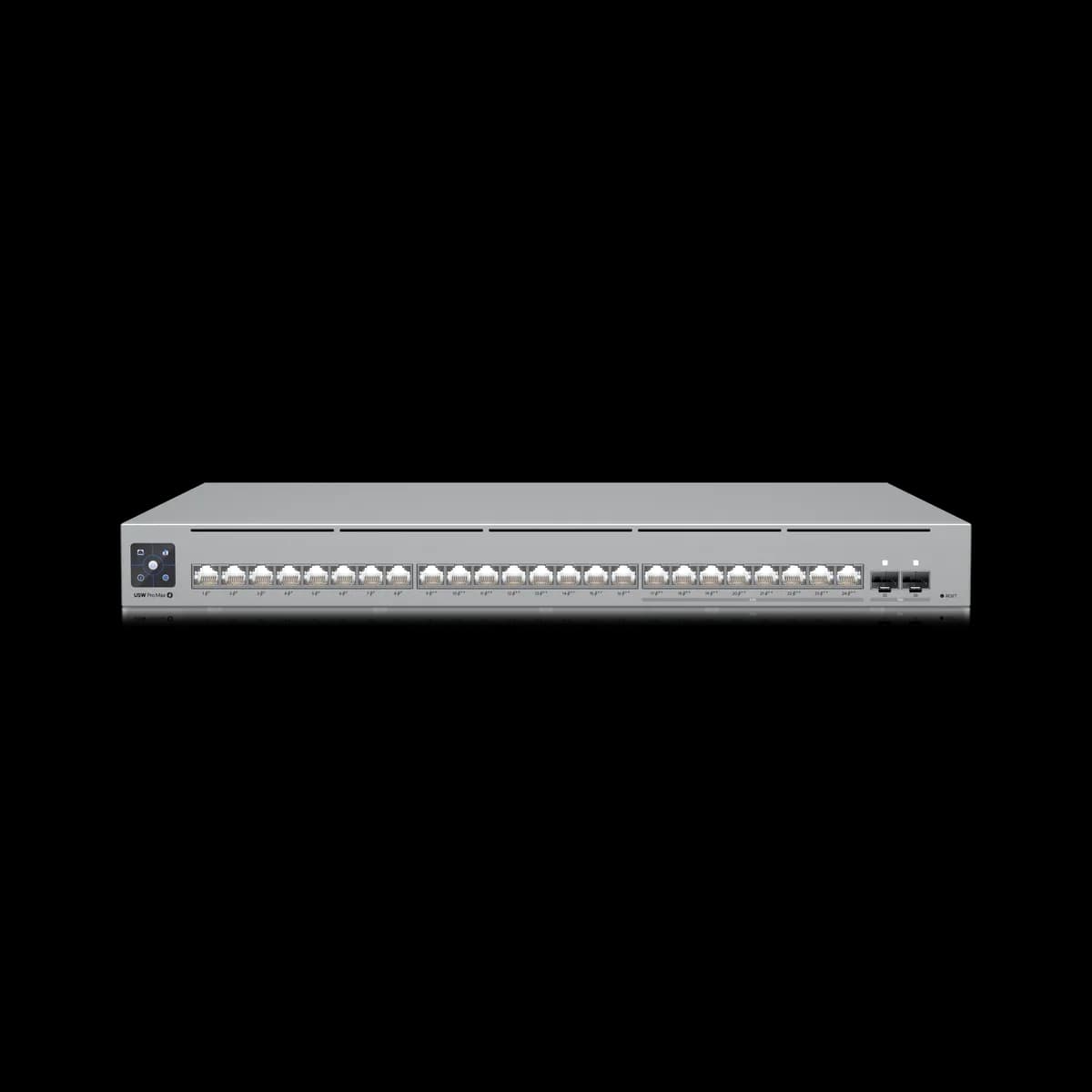
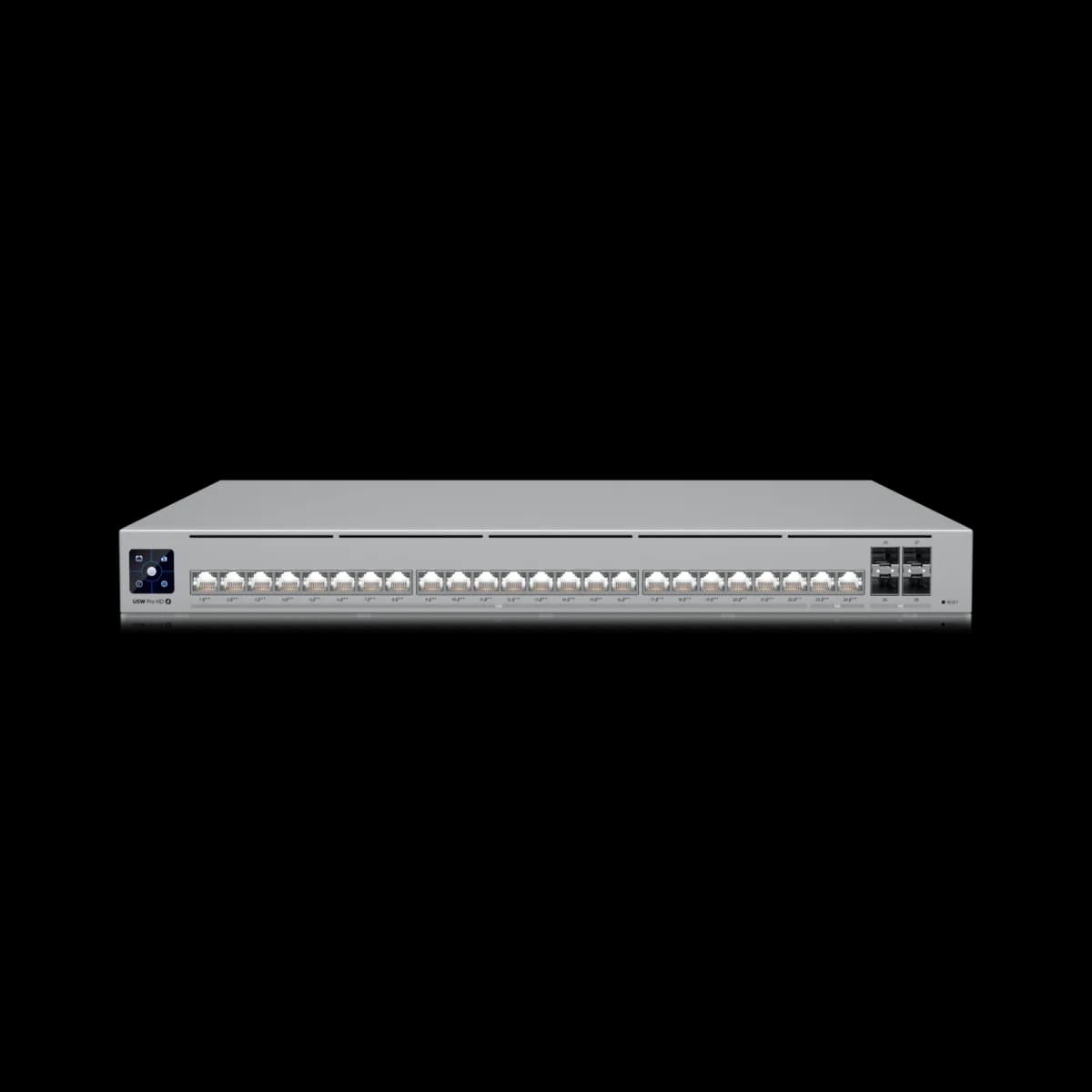
The $999 Pro HD 24 PoE makes all 24 ports multi-gig, two at 10 GbE, PoE++ on every port and 600 W. The $799 Pro Max 24 PoE has eight 2.5 GbE ports and 400 W.

Should I buy the UniFi Pro Max 24 PoE or the Pro HD 24 PoE?

The Pro Max 24 PoE ($799) has eight 2.5 GbE ports among 24, and the Pro HD 24 PoE ($999) has none slower than 2.5 GbE. Its 24 RJ45 ports are 22 at 2.5 GbE and two at 10 GbE, all PoE++, on a 600 W budget against 400 W. It also doubles the 10G SFP+ uplinks to four and the switching capacity to 230 Gbps. Both are 1U, run Layer 3 and take a USP-RPS. Buy the Pro Max when a few devices are multi-gig, and the Pro HD when most are, or when a 10 GbE PoE++ access point needs power and speed from one port.

Spec Comparison

SpecUniFi Pro Max 24 PoEUniFi Pro HD 24 PoE
RJ45 Ports(16) 1 GbE + (8) 2.5 GbE (8 PoE+, 16 PoE++)(22) 2.5 GbE + (2) 10 GbE (all 24 PoE++)
Uplinks(2) 10G SFP+(4) 10G SFP+
PoE Ports2424
PoE Standards802.3at / bt802.3at / bt
Total PoE Budget400 W600 W
Switching Capacity112 Gbps230 Gbps
Forwarding Rate83 Mpps171 Mpps
LayerLayer 2 + Layer 3Layer 2 + Layer 3
Form FactorRackmount (1U)Rackmount (1U)
Max Power Draw450 W (incl. PoE) / 50 W (excl. PoE)660 W (incl. PoE) / 60 W (excl. PoE)
Power AdapterInternalInternal
ManagementUniFi NetworkUniFi Network
Max PoE per Port60 W (PoE++)64 W (PoE++)
Non-Blocking Throughput56 Gbps115 Gbps
MAC Address Table16,00032,000
Power RedundancyYes (USP-RPS)Yes (USP-RPS)
Dimensions442 × 325 × 44 mm442 × 400 × 44 mm
Weight5.1 kg6.2 kg
Supported Rack Depth400–1,200 mm600–1,200 mm

Pricing & Positioning

What does $200 buy? Multi-gig on every port. The Pro HD 24 PoE ($999) lists (22) 2.5 GbE and (2) 10 GbE RJ45 ports, all PoE++, with 600 W and (4) 10G SFP+. The Pro Max 24 PoE ($799) lists (16) 1 GbE and (8) 2.5 GbE, with 400 W and (2) 10G SFP+. (Pro HD 24 PoE specs)

The Pro Max is a gigabit switch with a multi-gig corner. The Pro HD is a multi-gig switch with a 10 GbE corner. In fact, that one sentence settles most purchases, because it turns the question into a count of how many fast devices the rack holds.

The price per fast port makes the same point in dollars. Eight multi-gig ports for $799 is $100 each, and 24 for $999 is $42. That said, a port is only worth paying for when something uses it. A rack with five Wi-Fi 7 access points and a NAS fills six multi-gig ports, and the Pro Max still has two to spare.

Both are among the five switches this site tracks, and both sit in the rack tier with the $699 Pro 24 PoE. Accordingly, Pro 24 vs Pro Max 24 covers the step below this one, and how to choose a UniFi switch places all five.

Port Speeds: 8 Multi-Gig Ports Against 24

How many ports are faster than gigabit? Eight of 24 on the Pro Max 24 PoE, all at 2.5 GbE. All 24 on the Pro HD 24 PoE: 22 at 2.5 GbE and two at 10 GbE, which also negotiate 5G, 2.5G, 1G and 100M. Every port on both steps down to slower devices. (Pro Max 24 PoE specs)

What a 2.5 GbE port buys depends on the device at the far end. A Wi-Fi 7 access point such as the U7 Pro has a 2.5 GbE uplink, and a gigabit switch port caps it at 1 Gbps. For instance, a rack feeding ten of those APs runs out of fast ports on the Pro Max after the eighth.

The two 10 GbE ports are the feature with no equivalent on the Pro Max at all. After all, on the Pro Max 10G exists only on the SFP+ uplinks. On the Pro HD it also arrives on copper, where a workstation, a NAS such as the UNAS Pro 8, or an access point can take it without an SFP+ module.

Keep in mind that the other 22 ports stop at 2.5 GbE. A rack that wants 10 GbE to many desks is not describing this switch, and Ubiquiti's spec sheet is plain about the split.

PoE: 600 W and PoE++ on Every Port

How much power? The Pro HD 24 PoE lists 600 W with PoE++ on all 24 RJ45 ports, up to 64 W a port. The Pro Max 24 PoE lists 400 W with 16 PoE++ and 8 PoE+ ports, up to 60 W a port. Spread evenly, that is 25 W a port against 17 W. (Pro HD 24 PoE specs)

The extra 200 W matters more than the port classes do. A Wi-Fi 7 access point draws between 13 W and 43 W in the range this site tracks, and its PoE cameras draw between 9 W and 25 W each. As a result, a full Pro Max can run out of watts before it runs out of ports. PoE budget planning works through the arithmetic for a mixed load.

In addition, the 10 GbE ports are where PoE++ and speed finally meet. The E7 needs PoE++ at 43 W and has a 10 GbE uplink, and the U7 Pro XGS needs PoE++ at 29 W with the same port. On the Pro Max either one powers up on a 2.5 GbE PoE++ port and links at 2.5 GbE. On the Pro HD, one cable to a 10 GbE port carries both.

Note that there are two such ports, not 24. A site planning more than two 10 GbE access points on one switch still needs a different plan for the third. E7 vs U7 Pro XGS covers what each of those APs asks of the switch.

How much more capacity? About double on every published figure. The Pro HD 24 PoE lists (4) 10G SFP+, 230 Gbps of switching, 115 Gbps non-blocking and 171 Mpps. The Pro Max 24 PoE lists (2) 10G SFP+, 112 Gbps, 56 Gbps and 83 Mpps. The MAC table doubles too, from 16,000 to 32,000. (Pro Max 24 PoE specs)

Those figures follow directly from the ports. Each non-blocking number is simply the sum of them. The Pro Max adds up to 36 Gbps of RJ45 and 20 Gbps of SFP+, which is 56. The Pro HD adds up to 75 Gbps of RJ45 and 40 Gbps of SFP+, which is 115. Therefore neither switch is oversubscribed internally, and the larger fabric exists because the ports are faster.

Additionally, the uplinks are where the design shows. Twenty-four multi-gig ports behind two 10G uplinks would be 75 Gbps of access against 20 Gbps of uplink. Four SFP+ ports halve that ratio, and they leave room for a NAS or a second switch on 10G without giving up the path to the core. Switch uplinks and link aggregation explains how to size that ratio against real traffic.

However, Layer 3 does not separate them. Both list inter-VLAN routing, static routing, a DHCP server and DHCP relay, and the Layer 3 rows on the two spec sheets match line for line.

Rack Depth and the Power Behind It

Will it fit the same rack? Not always. Both are 1U and 442 mm wide, but the Pro HD 24 PoE is 400 mm deep against 325 mm, and Ubiquiti lists its supported rack depth from 600 mm where the Pro Max 24 PoE starts at 400 mm. It weighs 6.2 kg against 5.1 kg. (Pro HD 24 PoE specs)

Depth is the figure to check first. A shallow wall cabinet that takes the Pro Max may not take the Pro HD, because the supported range starts 200 mm further back. Measure the usable depth between the posts before ordering, and leave room for the cabling in front.

The power draw rises with the PoE budget. Ubiquiti lists a maximum of 660 W including PoE output for the Pro HD, against 450 W for the Pro Max. However, the switches themselves are close, at 60 W and 50 W excluding PoE. What's more, a fully loaded Pro HD is a meaningful load on a small UPS, so size the battery for the PoE devices and not only for the switch.

Of course, redundant power works the same way on both. Each lists one universal AC input and a USP-RPS DC input, so a rack with Ubiquiti's Redundant Power unit covers either one.

Which to Buy

Buy the Pro Max 24 PoE when the fast devices can be counted on two hands. These are the cases where it is simply the right switch:

  • Eight or fewer multi-gig devices. Wi-Fi 7 access points and a NAS take the 2.5 GbE ports, and cameras, phones and printers lose nothing on gigabit.
  • A PoE load under 400 W. Add up the draw before assuming the larger budget is needed.
  • A shallow rack. It is 325 mm deep and supported from a 400 mm rack depth.

Buy the Pro HD 24 PoE when the rack has outgrown that list. For example, it is the right switch once multi-gig devices pass eight, or once the PoE load passes 400 W. It is also the right switch when an E7 or a U7 Pro XGS should get PoE++ and 10 GbE from one port. Overall, the $200 is a small share of a build that already includes those devices.

However, if nothing in the rack exceeds gigabit, both are more switch than the job needs. The Pro 24 PoE also has 24 PoE ports and Layer 3, for $699, and the Switches hub sets all five side by side.

Frequently Asked Questions

Port speed, PoE and uplinks. The Pro HD 24 PoE ($999) lists 22 RJ45 ports at 2.5 GbE and two at 10 GbE, with PoE++ on all 24, a 600 W budget, four 10G SFP+ ports and 230 Gbps of switching capacity. The Pro Max 24 PoE ($799) lists 16 RJ45 ports at 1 GbE and eight at 2.5 GbE, with 16 PoE++ and 8 PoE+ ports, a 400 W budget, two 10G SFP+ ports and 112 Gbps. Both are 1U Layer 3 switches with Etherlighting, a 1.3" touchscreen and a USP-RPS input. The Pro HD is 400 mm deep against 325 mm.

Yes, two. Ubiquiti lists two 10 GbE RJ45 ports on the Pro HD 24 PoE, both PoE++, which negotiate 10G, 5G, 2.5G, 1G or 100M. The maximum PoE++ output is listed at 64 W a port. On the Pro Max 24 PoE, 10G is available only on the two SFP+ uplinks, which carry no PoE.

On paper, yes. Ubiquiti lists the E7 at PoE++ with a 43 W maximum draw and a 10 GbE uplink, and the Pro HD 24 PoE lists two 10 GbE RJ45 ports with PoE++ at up to 64 W a port. One cable to either of those ports therefore carries both. On the Pro Max 24 PoE an E7 can take power from a 2.5 GbE PoE++ port, and it then links at 2.5 GbE.

Up to 24 by port count, and as many as fit inside 600 W by power. Spread evenly that is 25 W a port, against 17 W a port on the Pro Max 24 PoE's 400 W. Every RJ45 port on the Pro HD is PoE++ at up to 64 W, so the budget runs out before the ports do on a load of high-draw devices. Add up each device's listed maximum draw to check.

Check before ordering. The Pro HD 24 PoE is 442 × 400 × 44 mm and Ubiquiti lists its supported rack depth as 600 to 1,200 mm. The Pro Max 24 PoE is 442 × 325 × 44 mm and is listed for 400 to 1,200 mm. Both are 1U, and the Pro HD is the heavier at 6.2 kg against 5.1 kg.

When the rack holds more than eight multi-gig devices, a PoE load above 400 W, or an access point that needs PoE++ and 10 GbE on one port, yes. Per multi-gig port the Pro HD costs $42 against $100. When only a few devices exceed gigabit and the PoE load is modest, the Pro Max 24 PoE does the same job for less, in a shallower chassis.