Comparison

UNAS Pro 4 vs UNAS Pro 8: Same Processor, Twice the Bays

The $799 UNAS Pro 8 doubles the $499 UNAS Pro 4's bays and memory, swaps its 1 GbE RJ45 for 10 GbE and adds dual power modules. Processor and NVMe cache match.

Should I buy the UniFi UNAS Pro 4 or the UNAS Pro 8?

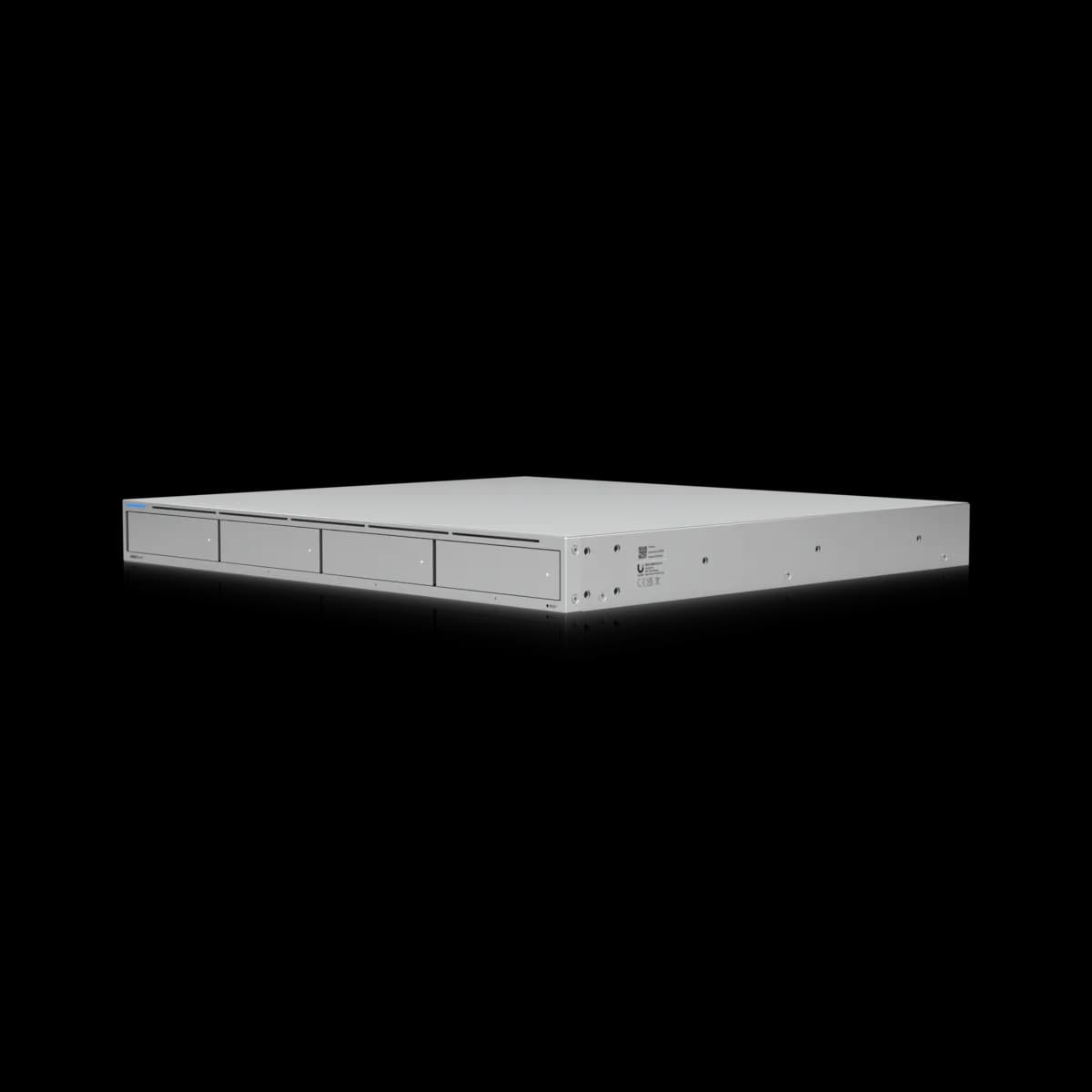
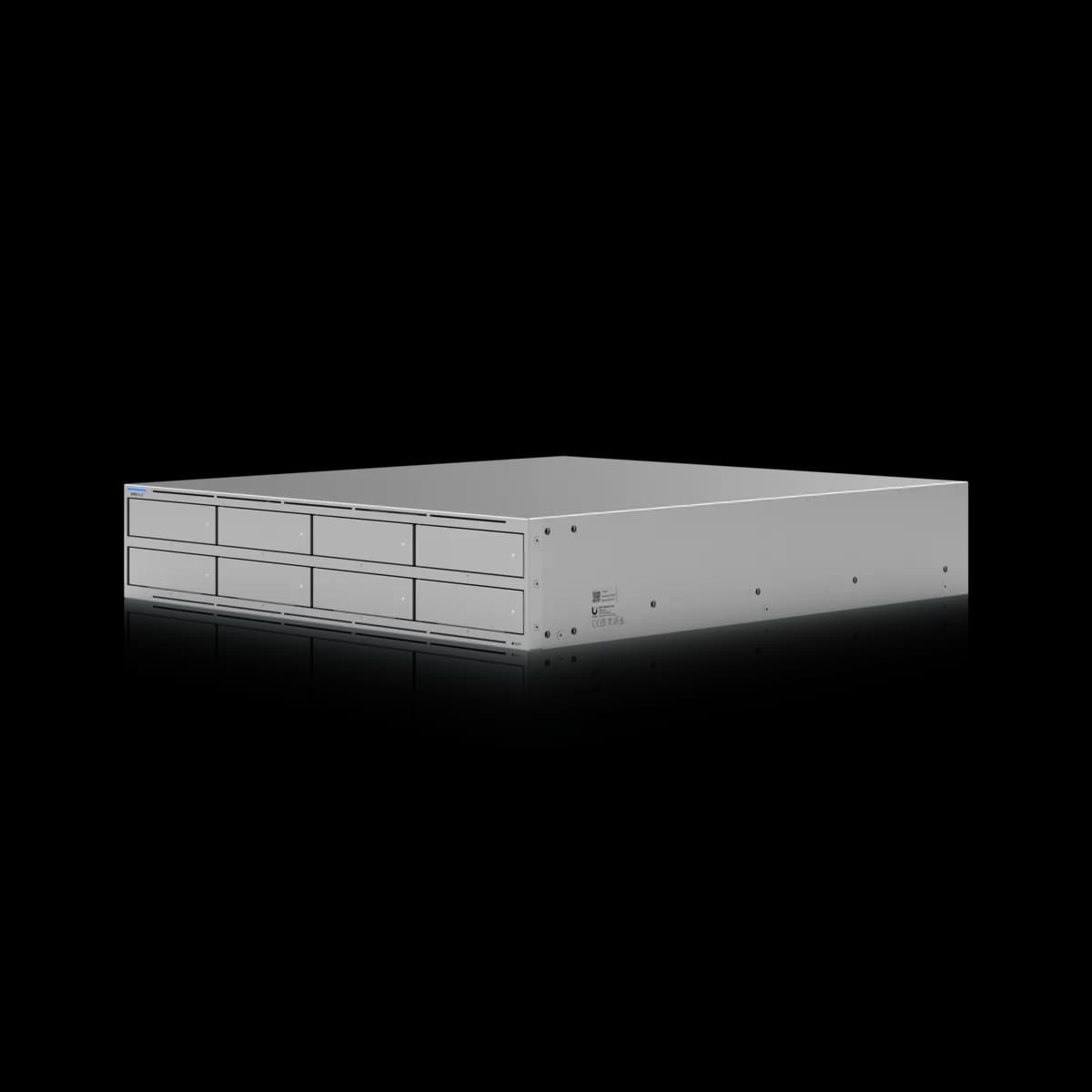
The UNAS Pro 8 ($799) is the UNAS Pro 4 ($499) with twice the bays, twice the memory and power redundancy built in. Both list the same quad-core Cortex-A57 at 2.0 GHz, two M.2 NVMe cache slots and a pair of 10G SFP+ ports. The Pro 8 takes eight drives and 16 GB of memory, swaps the 1 GbE RJ45 for a 10 GbE one, lists multiple RAID groups where the Pro 4 lists one, and carries two hot-swappable power modules instead of a USP-RPS input. It is 2U against 1U, and 80 mm deeper. Buy the Pro 4 when four bays will hold the data, and the Pro 8 when they will not.

Spec Comparison

SpecUniFi UNAS Pro 4UniFi UNAS Pro 8
ProcessorQuad-core ARM Cortex-A57 at 2.0 GHzQuad-core ARM Cortex-A57 at 2.0 GHz
System Memory8 GB16 GB
Drive Capacity(4) 2.5/3.5" HDD / SSD + (2) M.2 NVMe SSD(8) 2.5/3.5" HDD / SSD + (2) M.2 NVMe SSD
SSD CacheYesYes
Max NVMe SSD Capacity4 TiB4 TiB
Max Power Budget for Drives125 W225 W
Networking Interface(2) 10G SFP+ (10G only) + (1) GbE RJ45 (1G/100M/10M)(2) 10G SFP+ (10G only) + (1) 10 GbE RJ45 (10G/5G/2.5G/1G/100M)
RAID TypesRAID 5, RAID 6, RAID 10RAID 5, RAID 6, RAID 10
RAID GroupsSingleMultiple
File ProtocolsSMB, NFSSMB, NFS
SnapshotsYesYes
File EncryptionYesYes
Time Machine BackupYesYes
Backup DestinationsRemote UNAS, CIFS/SMB server, cloud (Google Drive, OneDrive, Dropbox, Amazon S3, Backblaze B2, Wasabi)Remote UNAS, CIFS/SMB server, cloud (Google Drive, OneDrive, Dropbox, Amazon S3, Backblaze B2, Wasabi)
Power RedundancyYes (USP-RPS)Yes (dual hot-swappable PSUs)
Power SupplyAC/DC, internal, 150 W(2) hot-swappable AC/DC 550 W power modules
Form FactorRackmount (1U)Rackmount (2U)
Dimensions442.4 × 400 × 43.7 mm442.4 × 480 × 87.4 mm
Weight6.7 kg11.5 kg
Max Power Draw150 W250 W
Hot Spare SupportYes

Pricing & Positioning

What does $300 buy? Four more bays, and more redundancy around them. The UNAS Pro 8 ($799) lists eight 2.5/3.5" bays and 16 GB of memory against four bays and 8 GB on the UNAS Pro 4 ($499). It also lists a 10 GbE RJ45, multiple RAID groups and two hot-swappable 550 W power modules. (UNAS Pro 8 specs)

These two share a processor, a cache design and a pair of SFP+ ports, which makes this a clean matchup. Against the seven-bay UNAS Pro the Pro 8 changes nearly everything. Against the Pro 4 it changes a short list, and the list is easy to price.

In fact, the larger unit is the cheaper one per bay. The Pro 4 works out to $125 a bay and the Pro 8 to $100, so the 60% premium buys 100% more room. However, a bay is only worth paying for once there is a drive to put in it, and Ubiquiti sells the drives separately.

Both are among the three rack-mount models this site tracks, and the Network Storage hub sets all three side by side. Additionally, UNAS Pro vs UNAS Pro 8 covers the seven-bay unit that shares the Pro 4's price.

What Does Not Change

Is the Pro 8 faster? Not on the processor, the cache or the SFP+ ports. Both list a quad-core ARM Cortex-A57 at 2.0 GHz, (2) M.2 NVMe bays with an SSD Cache feature and a 4 TiB maximum NVMe capacity, and (2) 10G SFP+ ports marked 10G only. The published differences are memory and the RJ45. (UNAS Pro 4 specs)

This section decides more purchases than the price does, because the intuition runs the wrong way. After all, a unit that costs 60% more reads as the faster machine. On the processor and the cache, it is the same machine with more room in it.

Of course, memory is the exception, and it is a real one. The Pro 8 lists 16 GB against 8 GB. Ubiquiti publishes no throughput figure for either model, so this page will not say what the extra memory is worth in megabytes a second. It is reasonable to expect a busier share to benefit, and unreasonable to put a number on it.

Most of the software list does not move either. Both sheets show SMB and NFS, RAID 5, 6 and 10, snapshots, file encryption, Time Machine backup, and backup to a remote UNAS, an SMB server or a cloud service. Accordingly, the two rows that do differ, RAID groups and hot spares, get the next section to themselves.

RAID Groups, Hot Spares and Four-Bay Arithmetic

What differs in RAID? The layout options, not the levels. Both list RAID 5, RAID 6 and RAID 10. The UNAS Pro 8 lists Multiple RAID groups and a Hot Spare Support row. The UNAS Pro 4 lists a Single RAID group, and its sheet carries no hot-spare row at all. (UNAS Pro 4 specs)

Note that the missing row is a fact about the spec sheet. Ubiquiti prints "Hot Spare Support" for the Pro 8 and for the seven-bay UNAS Pro, and prints nothing for the Pro 4. This page will not read that as "unsupported", because the sheet does not say so. A build that depends on a hot spare should confirm it with Ubiquiti first.

The arithmetic of four bays matters more than either row. Standard RAID 6 spends two drives on parity, and RAID 10 mirrors half the set. As a result, a four-bay array in either level keeps two drives' worth of capacity, which is half of what was bought. RAID 5 keeps three, with one drive of protection.

Eight bays change those fractions. For instance, RAID 6 across eight drives keeps six, so the parity cost falls from a half to a quarter. That is the strongest capacity argument for the Pro 8, and it holds at any drive size.

The Copper Port Is the Network Difference

What are the ports? The SFP+ side is identical: (2) 10G SFP+, listed as 10G only on both. The RJ45 is not. The UNAS Pro 4 lists (1) GbE RJ45 at 1G, 100M or 10M. The UNAS Pro 8 lists (1) 10 GbE RJ45 that negotiates 10G, 5G, 2.5G, 1G or 100M. (UNAS Pro 8 specs)

On the Pro 4, anything faster than gigabit has to arrive over SFP+, and at 10G. That suits a rack with a 10G switch in it. The USW Pro 24 PoE and USW Pro Max 24 PoE each carry two 10G SFP+ ports. Keep in mind that those two ports are usually the switch's uplinks as well.

The Pro 8's copper port removes that constraint. It links at 2.5G or 5G to multi-gig switches and clients, and at 10G to a port such as the RJ45 uplink on the USW Flex 2.5G 8 PoE. What's more, it leaves both SFP+ ports free.

Neither sheet says how the two SFP+ ports may be combined, so this page does not either. Be aware that a bonded pair would not double a single file copy in any case. Switch uplinks and link aggregation sets out why, and it names NAS hosts as one of the cases where a bond does earn its ports.

Rack Space and Power

What does each cost to install? The UNAS Pro 4 is 1U, 400 mm deep and 6.7 kg, with a 150 W maximum draw. The UNAS Pro 8 is 2U, 480 mm deep and 11.5 kg, with a 250 W maximum. Both are 442.4 mm wide, and both list the same supported rack depth for four-post racks. (UNAS Pro 4 specs)

However, power is where the two designs part company. The Pro 4 lists one internal 150 W supply and a USP-RPS DC input. The Pro 8 lists two hot-swappable 550 W modules on two AC inputs. As a result, both sheets say yes to power redundancy, and only one of them says it without a second purchase.

That purchase is easy to price. Ubiquiti lists the USP-RPS at $399, which makes a Pro 4 with redundant power a $898 build. That is $99 more than a Pro 8, which has twice the bays. Naturally, a rack that already holds a USP-RPS with a free output changes the sum, and the $300 gap returns.

The drive budgets rise with the bay counts, to 125 W for the Pro 4 and 225 W for the Pro 8. Ubiquiti does not say how either figure divides between the bays and the two M.2 slots. Treat each as a ceiling to check a planned drive set against.

Which to Buy

Buy the UNAS Pro 4 when the data fits and the rack is tight. These are the cases it wins outright:

  • Four bays are enough for years, not months. Size the array after parity, not before it, and leave room to grow.
  • The rack is short on height or depth. 1U and 400 mm go where 2U and 480 mm will not.
  • There is a 10G SFP+ switch port free, and a USP-RPS already in the rack. Both of the Pro 4's compromises then cost nothing.

Buy the UNAS Pro 8 for the opposite cases. For instance, it is the right unit when RAID 6 on four bays gives away too much, or when clients connect over multi-gig copper. It is also the right unit when redundant power is required and no RPS is installed. Overall, it is the same processor and cache with fewer corners cut around them, and the per-bay price is lower.

That said, if capacity is the whole brief and cache is not, the seven-bay UNAS Pro costs the same $499 as the Pro 4. Camera recording belongs to a different appliance, and NVR G2 vs NVR G2 Pro is the place to start.

Frequently Asked Questions

Bays, memory, one port and the power design. The UNAS Pro 8 ($799) lists eight 2.5/3.5" bays and 16 GB of memory against four bays and 8 GB on the UNAS Pro 4 ($499). Its RJ45 is 10 GbE where the Pro 4's is 1 GbE, it lists multiple RAID groups and hot-spare support where the Pro 4 lists a single group, and it carries two hot-swappable 550 W power modules where the Pro 4 has one internal supply and a USP-RPS input. The processor, the two M.2 NVMe cache slots and the pair of 10G SFP+ ports are the same. The Pro 8 is 2U and 480 mm deep against 1U and 400 mm.

Not on any published compute or cache figure. Both list a quad-core ARM Cortex-A57 at 2.0 GHz, two M.2 NVMe bays with SSD cache and a 4 TiB maximum NVMe capacity, and two 10G SFP+ ports. The Pro 8 has twice the memory, 16 GB against 8 GB, and a 10 GbE RJ45 against a 1 GbE one. Ubiquiti publishes no throughput figure for either model.

Its spec sheet does not list one. Ubiquiti prints a Hot Spare Support row for the UNAS Pro 8 and the UNAS Pro, and no such row for the UNAS Pro 4, which also lists a single RAID group where the other two list multiple. The sheet does not state that hot spares are unsupported, so a build that depends on one should confirm it with Ubiquiti.

Two drives' worth. Standard RAID 6 spends two drives on parity, so four bays keep half of the raw capacity, and RAID 10 keeps the same half by mirroring. RAID 5 keeps three drives' worth with one drive of protection. On the eight-bay UNAS Pro 8 the same RAID 6 keeps six of eight, so the parity cost falls from a half to a quarter.

Not necessarily. The UNAS Pro 8 is 2U and 480 mm deep at 11.5 kg, against 1U and 400 mm at 6.7 kg for the UNAS Pro 4. Both are 442.4 mm wide, and both list rails for four-post racks with square holes and post depths from 600 to 1066 mm. The extra rack unit and the extra 80 mm of depth are the two figures to check.

The UNAS Pro 4 lists one internal 150 W supply and a USP-RPS DC input, so redundancy needs Ubiquiti's separate Redundant Power unit, listed at $399. That makes a UNAS Pro 4 with redundant power a $898 build, $99 more than a UNAS Pro 8 with two hot-swappable 550 W power modules listed on its spec sheet. A rack that already has a USP-RPS with a free output pays nothing extra.