Comparison

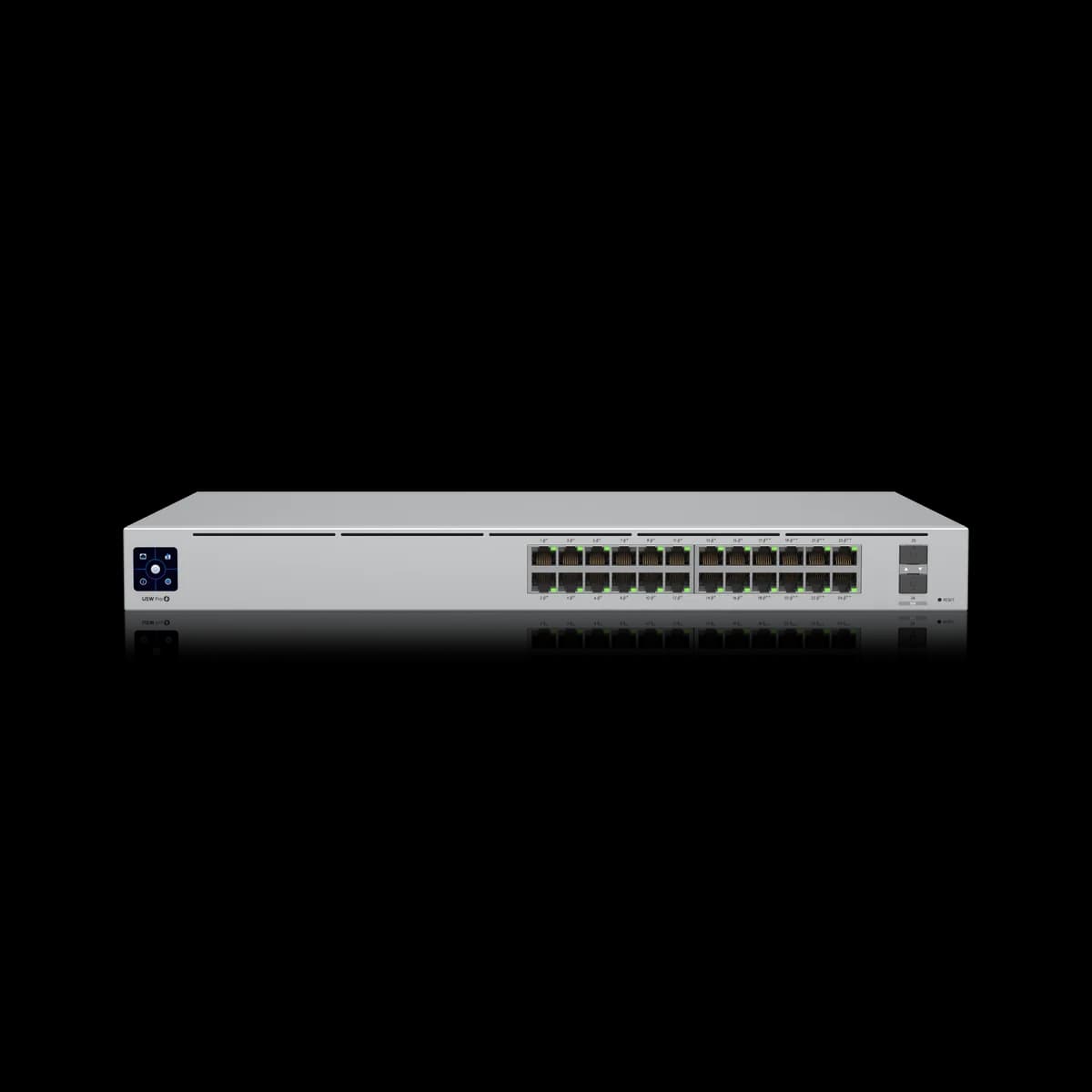
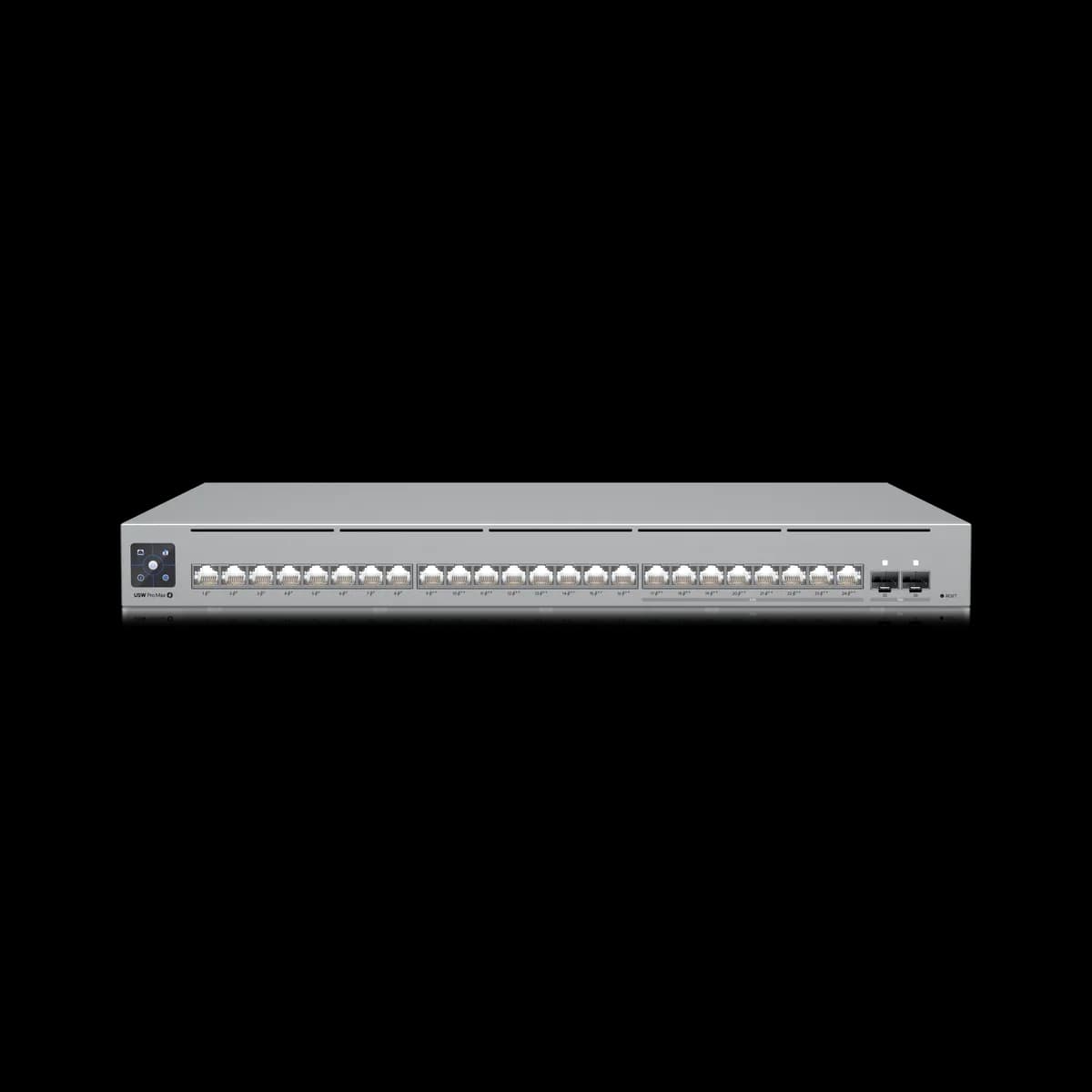
UniFi Pro 24 PoE vs Pro Max 24 PoE

The $699 Pro 24 PoE and $799 Pro Max 24 PoE share 400 W PoE, dual 10G SFP+, and Layer 3. The Pro Max adds eight 2.5 GbE ports and more PoE++. Which to buy?

Should I buy the UniFi Pro 24 PoE or the Pro Max 24 PoE?

For most 24-port UniFi racks the Pro 24 PoE ($699) is enough — 24 gigabit PoE ports, dual 10G SFP+ uplinks, and Layer 3 routing. Pay the extra $100 for the Pro Max 24 PoE ($799) only if you are deploying Wi-Fi 6E/7 access points or 2.5 GbE clients: it upgrades eight ports to 2.5 GbE, doubles the PoE++ port count to 16, and runs a larger 112 Gbps fabric. The PoE budget (400 W), uplinks, and routing are identical.

Spec Comparison

SpecUniFi Pro 24 PoEUniFi Pro Max 24 PoE
RJ45 Ports(24) 1 GbE (16 PoE+, 8 PoE++)(16) 1 GbE + (8) 2.5 GbE (8 PoE+, 16 PoE++)
Uplinks(2) 10G SFP+(2) 10G SFP+
PoE Ports2424
PoE Standards802.3af / at / bt802.3at / bt
Total PoE Budget400 W400 W
Switching Capacity88 Gbps112 Gbps
Forwarding Rate65 Mpps83 Mpps
LayerLayer 2 + Layer 3Layer 2 + Layer 3
Form FactorRackmount (1U)Rackmount (1U)
Max Power Draw450 W (incl. PoE)450 W (incl. PoE)
Power AdapterInternalInternal
ManagementUniFi NetworkUniFi Network

Pricing & Positioning

What does the extra $100 buy? The Pro 24 PoE lists at $699 and the Pro Max 24 PoE at $799. That premium adds no ports and no PoE budget — both carry 24 PoE ports and a 400 W budget. It buys eight 2.5 GbE ports, twice the PoE++ ports, and a larger switching fabric. (Pro Max specs)

Both switches occupy the same slot in a UniFi rack: a 1U, 24-port, Layer 3 PoE access switch with dual 10G SFP+ uplinks. The Pro 24 PoE is the all-gigabit default; the Pro Max 24 PoE is the multi-gig variant of the same design. They are not aimed at different network sizes — they are aimed at different port-speed needs.

If you are still mapping the lineup, start with how to choose a UniFi switch or browse the Switches hub. The decision here comes down to one question: do any of your devices need more than a gigabit?

2.5 GbE vs All-Gigabit Ports

Which one has multi-gig ports? Only the Pro Max 24 PoE: eight of its 24 RJ45 ports run at 2.5 GbE, the other 16 stay at 1 GbE. The Pro 24 PoE runs all 24 ports at 1 GbE. On a gigabit network the two feel identical; the 2.5 GbE ports only pull ahead for multi-gig access points or clients. (Pro Max specs)

This is the entire reason the Pro Max exists. Wi-Fi 6E and Wi-Fi 7 access points routinely push past a single gigabit on the wired side, and a 2.5 GbE uplink to the AP removes that bottleneck. The same applies to 2.5 GbE NAS boxes and workstations. If none of your devices exceed 1 Gbps, the all-gigabit Pro 24 PoE loses nothing by comparison.

Note that only a third of the Pro Max's ports are 2.5 GbE — it is a mixed switch, not an all-multi-gig one. If your multi-gig footprint is small and you do not need 24 ports, a compact Flex 2.5G 8 PoE can cover it instead; that trade-off is laid out in Flex 2.5G vs Pro Max 24 PoE.

PoE Budget & PoE++ Ports

Same PoE budget? Yes — both deliver a 400 W total PoE budget. The difference is distribution: the Pro Max has 16 PoE++ (60 W) ports to the Pro 24's 8, so it can drive more high-draw devices — PTZ cameras, Wi-Fi 7 APs, door-access hubs — at full power before that shared budget runs out. (Pro 24 specs)

The headline 400 W is the same number, so total PoE capacity is not the differentiator. What changes is how many ports can each pull the top PoE++ tier at once. With 16 PoE++ ports versus 8, the Pro Max suits installs dense with power-hungry endpoints; the Pro 24's eight PoE++ ports are plenty for a typical mix of APs, cameras, and phones. Either way, add up your devices' draw against that shared 400 W — it is the real ceiling, as the buying guide explains.

Bigger fabric? The Pro Max switches 112 Gbps (83 Mpps) against the Pro 24's 88 Gbps (65 Mpps) — extra capacity to match its faster ports. Uplinks are identical: two 10G SFP+ on both, so either one drops into a 10G aggregation core exactly the same way. (Pro Max specs)

The 112-vs-88 Gbps gap simply tracks the 2.5 GbE ports — a bigger fabric is needed to switch faster ports at line rate, and it is not a reason to buy the Pro Max on its own. The part that matters for your topology is the uplinks, and there both are the same: two 10G SFP+ ports feeding a 10G core or an aggregation switch. Neither switch is your aggregation layer — both are access switches that uplink at 10G.

What's Identical

What you are not paying extra for. Both are 1U rackmount, both run Layer 2 + Layer 3 routing, and both carry the same 400 W PoE budget and dual 10G SFP+ uplinks. The $100 gap buys only the 2.5 GbE ports, extra PoE++, and a larger fabric — not routing, uplinks, or PoE capacity. (Pro 24 specs)

This is the clarifying point. Because Layer 3, the 10G uplinks, the 400 W budget, and the 1U form factor are shared, the Pro 24 PoE is not a "lesser" switch — it is the same switch without multi-gig access ports. If you do not have multi-gig devices, you give up nothing by saving the $100. If you do, the Pro Max is the only one of the two that serves them.

Who Should Buy Which

The two switches rarely compete for the same buyer once you have written down whether anything on your network exceeds a gigabit. Here is how the decision breaks.

Buy the Pro 24 PoE if:

  • Your network is gigabit. Every wired device tops out at 1 GbE, so 24 gigabit PoE ports cover the floor with nothing wasted.
  • You want Layer 3 and 10G uplinks at the lowest 24-port price. Routing, dual 10G SFP+, and a 400 W budget for $699.
  • Your PoE mix is typical. APs, cameras, and phones sit comfortably inside eight PoE++ ports and the shared 400 W.

Buy the Pro Max 24 PoE if:

  • You run Wi-Fi 6E or Wi-Fi 7 APs. Their wired throughput can exceed 1 Gbps; the eight 2.5 GbE ports remove that bottleneck.
  • You have 2.5 GbE clients or NAS. Multi-gig workstations and storage get their full speed.
  • You pack in high-draw PoE devices. Sixteen PoE++ ports drive more 60 W endpoints at once.

Still deciding across the whole range? Start with how to choose a UniFi switch, or if you are sizing a smaller closet, compare the Lite 16 PoE vs Flex 2.5G 8 PoE.

Frequently Asked Questions

It depends on whether you have multi-gig devices. If your network is entirely gigabit, the Pro 24 PoE gives you the same Layer 3 routing, dual 10G SFP+ uplinks, and 400 W PoE budget for $100 less. If you run Wi-Fi 6E/7 access points or 2.5 GbE clients, the Pro Max's eight 2.5 GbE ports are worth the premium.

Eight of its 24 RJ45 ports run at 2.5 GbE; the other 16 are 1 GbE. The Pro 24 PoE has no 2.5 GbE ports — all 24 of its ports are 1 GbE.

Yes. Both are Layer 2 + Layer 3 switches with inter-VLAN routing, a DHCP server, and static routing. Layer 3 is not a differentiator between them.

Yes, both have a 400 W total PoE budget. The difference is the number of PoE++ (60 W) ports: the Pro Max has 16 and the Pro 24 has 8, so the Pro Max can power more high-draw devices at full PoE++ before the shared 400 W budget is reached.

Yes. Both the Pro 24 PoE and the Pro Max 24 PoE have two 10G SFP+ uplink ports, so either drops into a 10G aggregation core the same way.