Comparison

UniFi UDM-SE vs Pro Max: PoE or Headroom

The $499 Dream Machine SE has 180 W of PoE the $599 Pro Max lacks. The Pro Max answers with 5 Gbps IPS, 8 GB, two drive bays and double the ratings.

Should I buy the UniFi Dream Machine SE or the Dream Machine Pro Max?

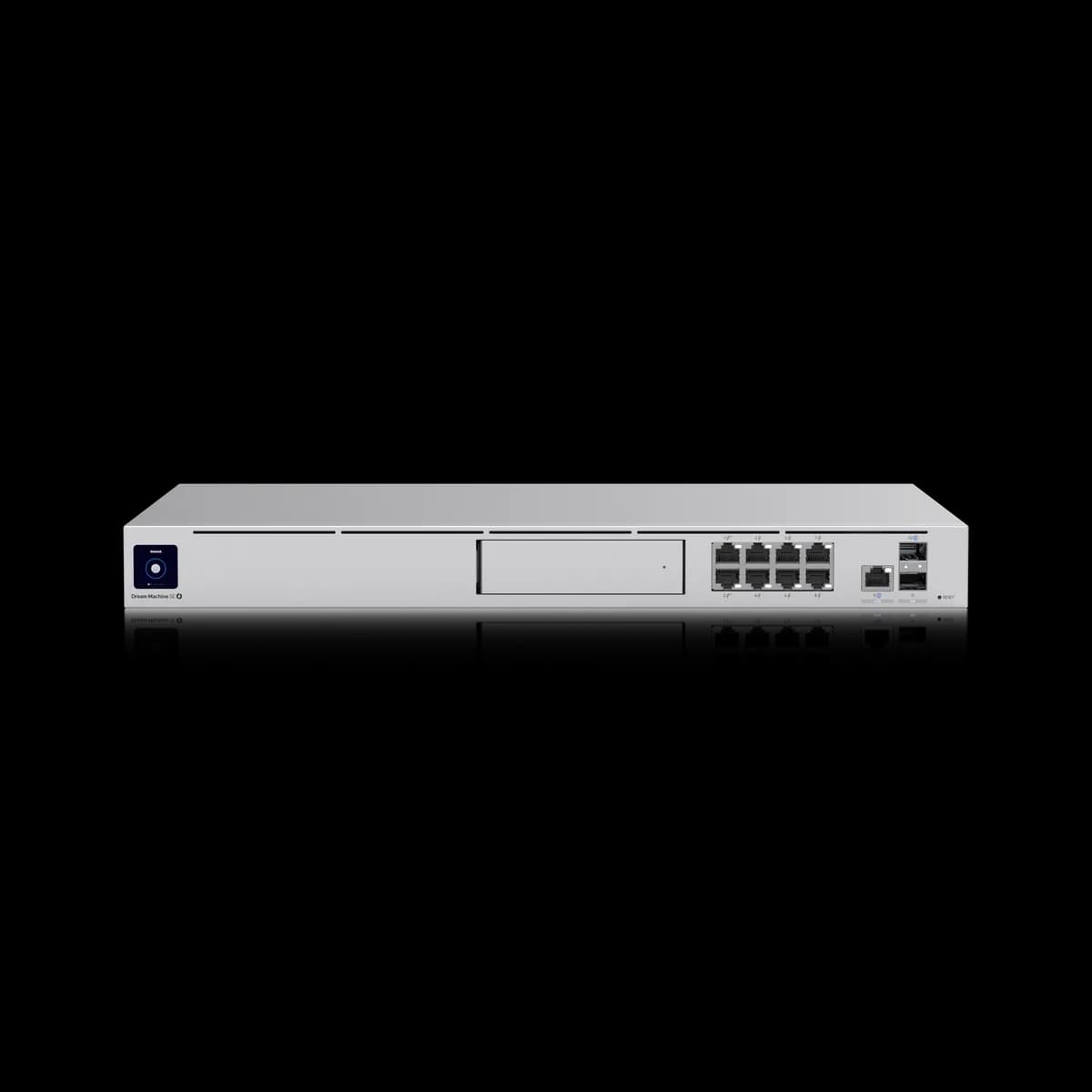
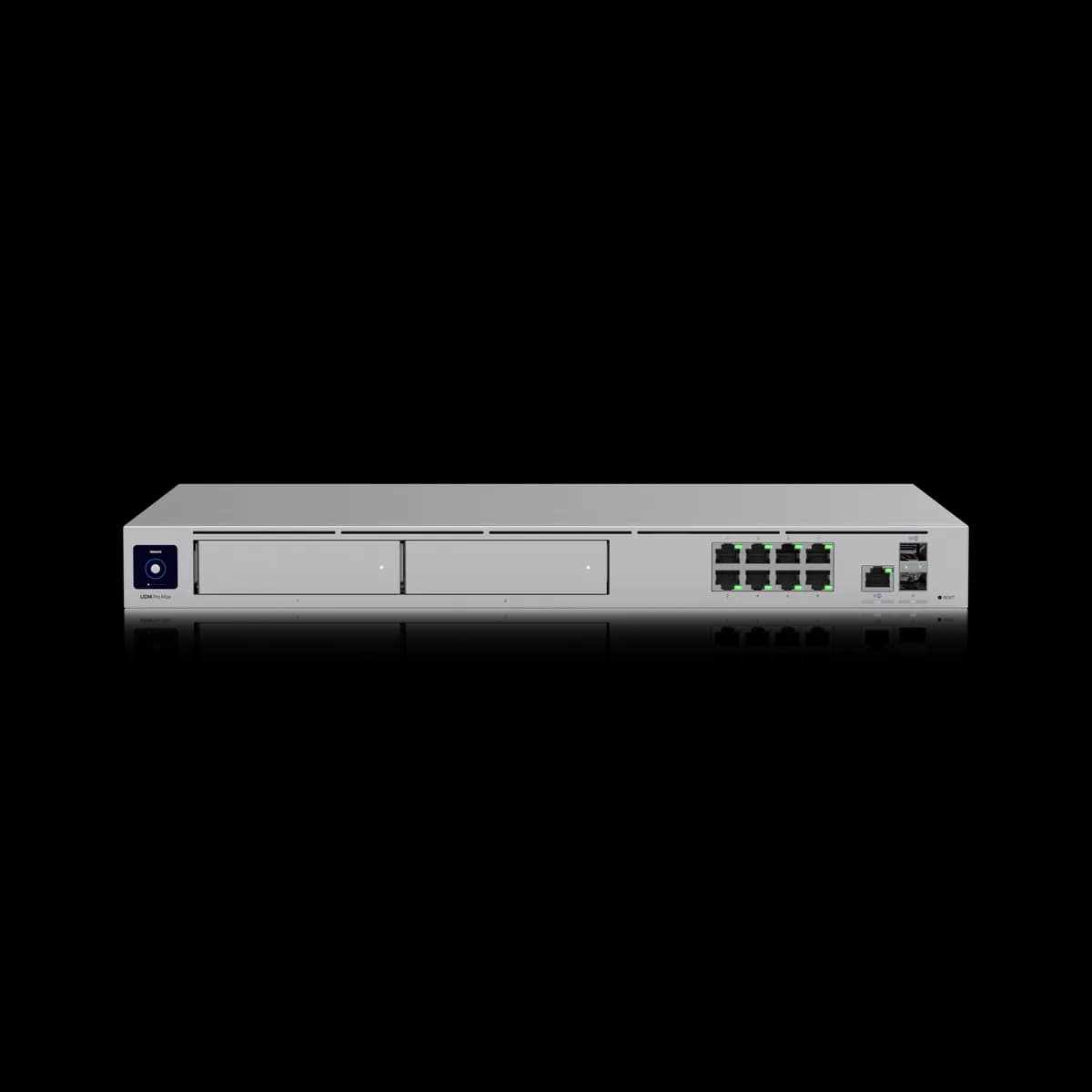
These two rack gateways trade in opposite directions. The Dream Machine SE ($499) is the only one with PoE, at 180 W across eight ports, which powers cameras and access points directly. The Dream Machine Pro Max ($599) has none, and spends its extra $100 on capacity: 5 Gbps of IDS/IPS against 3.5, 8 GB of memory against 4, two drive bays against one, and ratings of 200+ devices and 50 HD cameras against 100+ and 24. Buy the SE to power devices from the rack. Buy the Pro Max when the site is larger than the SE's ratings.

Spec Comparison

SpecUniFi Dream Machine SEUniFi Dream Machine Pro Max
ProcessorQuad-core ARM Cortex-A57 @ 1.7 GHzQuad-core ARM Cortex-A57 @ 2.0 GHz
System Memory4 GB8 GB
On-Board Storage16 GB eMMC + 128 GB SSD32 GB eMMC + 128 GB SSD
Protect Storage(1) 3.5" HDD bay + 128 GB SSD(2) 3.5" HDD bays + 128 GB SSD
WAN Port(1) 10G SFP+ + (1) 2.5 GbE RJ45 (default)(1) 10G SFP+ + (1) 2.5 GbE RJ45 (default)
LAN Ports(8) GbE RJ45 + (1) 2.5 GbE RJ45 + (2) 10G SFP+ total(8) GbE RJ45 + (1) 2.5 GbE RJ45 + (2) 10G SFP+ total
PoE Output180 W total budget (PoE 15.4 W / PoE+ 30 W per port)
IDS/IPS Throughput3.5 Gbps5 Gbps
Form FactorRackmount (1U)Rackmount (1U)
Max UniFi Devices100+200+
Max Clients1,000+2,000+
Protect Cameras(24) HD, (14) 2K, (8) 4K(50) HD, (25) 2K, (15) 4K
Dimensions442.4 × 43.7 × 285.6 mm442.4 × 43.7 × 285.6 mm
Weight5 kg4.7 kg
Operating Temp-10 to 40 °C-10 to 40 °C
Max Power Draw50 W (excl. PoE output)60 W

Pricing & Positioning

Why does the cheaper one have PoE? Because they answer different buildings. The Dream Machine SE at $499 carries a 180 W PoE budget. The Dream Machine Pro Max at $599 has none, and spends the difference on capacity. (Dream Machine Pro Max specs)

It is the one pairing among the eight gateways this site tracks where the more expensive unit does less on a row that matters daily. A buyer who assumes the dearer box is a superset will be wrong about the one feature they may have been buying it for.

Both are 1U units in the same 442.4 × 43.7 × 285.6 mm case with a 1.3-inch touchscreen, both take 3.5-inch Protect drives, and both carry two 10G SFP+ ports and a 2.5 GbE copper WAN. How to choose a UniFi gateway sets them beside the desktop units.

180 W, or None

Which one powers devices? Only the Dream Machine SE, at 180 W total — up to 15.4 W per PoE port and 30 W per PoE+ port. Ubiquiti publishes no PoE output for the Dream Machine Pro Max, so its devices need a separate switch. (Dream Machine SE specs)

That budget carries roughly eight G6 Bullet cameras at 9.9 W apiece, or a smaller mix including access points — a U7 Pro takes up to 21 W on PoE+. PoE budget planning works the numbers for a specific set.

The practical consequence is a rack unit's worth of difference. Behind the Pro Max, a PoE switch is not optional once there is a single camera, which adds cost and another unit to the rack that the SE's price already includes.

Where the Pro Max Pulls Ahead

What does the Pro Max do better? Scale. It lists 5 Gbps of IDS/IPS against the Dream Machine SE's 3.5 Gbps, 8 GB of memory against 4 GB, and ratings for 200+ devices, 2,000+ users and 50 HD cameras against 100+, 1,000+ and 24. (Dream Machine SE specs)

Those ratings are the reason to accept losing PoE, and they only matter at a size where a separate PoE switch was inevitable anyway. A site with 150 UniFi devices is a site with switches in the rack already.

The second 3.5-inch drive bay belongs to the same argument, because doubling camera capacity is of little use if the footage has nowhere to land. The Pro Max also runs its A57 cores at 2.0 GHz against 1.7 GHz.

Below those ceilings the extra $100 buys nothing a smaller site can feel, while the PoE it gives up is felt on the first camera.

Storage, Draw & Weight

Storage and power? The Dream Machine Pro Max takes two 3.5-inch drives and draws 60 W. The Dream Machine SE takes one and draws 50 W excluding PoE output, which its 180 W budget then sits on top of. Both add a built-in 128 GB SSD for the system. (Dream Machine Pro Max specs)

Size a UPS from the loaded figures rather than the labels. A fully committed SE can pass 180 W to devices on top of its own 50 W, which makes it the heavier draw of the two in practice even though its headline number is lower.

Weight follows the internals: 5 kg for the SE against 4.7 kg for the Pro Max, the PoE circuitry accounting for the difference. Both operate from -10 to 40 °C.

When Neither Is the Answer

A cheaper way to get both? Pair a UDM-Pro at $379 with a PoE switch. That splits the two jobs across two units and is often cheaper than either of these, at the cost of a second rack unit. (Dream Machine SE specs)

A gateway with PoE is a convenience rather than a capability, since a switch does the same job with more ports and a larger budget. The SE earns its price in small racks where 180 W covers everything and the saved unit matters.

The reverse case is worth stating too. If the site needs both very high capacity and a lot of PoE, the answer is the Pro Max plus a switch, and the SE was never in the running. UDM-Pro vs Dream Machine Pro Max covers that step without the PoE question attached.

Who Should Buy Which

The dearer unit is not the superset here, so decide on powered devices first and ceilings second.

Buy the Dream Machine SE if:

  • Cameras or access points need power from the rack. 180 W is the only PoE in the rack line.
  • Your site fits 100+ devices and 24 HD cameras. Those ratings cover most small businesses.
  • You want one unit doing two jobs. Gateway and PoE switch in 1U.

Buy the Dream Machine Pro Max if:

  • The device or camera count is past the SE's ratings. 200+ devices, 50 HD cameras, two drive bays.
  • A PoE switch is already racked. The SE's advantage disappears, and the headroom is what is left.
  • The line is faster than 3.5 Gbps with inspection on. That is the SE's ceiling and the Pro Max's is 5 Gbps.

Frequently Asked Questions

No. Ubiquiti publishes no PoE output for the Dream Machine Pro Max, despite it costing $100 more than the Dream Machine SE, which provides 180 W. Cameras and access points behind a Pro Max need a PoE switch or injectors.

They are better at different things. The SE ($499) powers up to 180 W of cameras and access points from the rack. The Pro Max ($599) has no PoE but doubles memory, device capacity, user capacity and camera capacity, adds a second drive bay, and raises IDS/IPS from 3.5 to 5 Gbps.

The Dream Machine SE is rated for 24 HD, 14 2K, or 8 4K cameras on one 3.5-inch drive. The Dream Machine Pro Max is rated for 50 HD, 25 2K, or 15 4K on two bays. Both also carry a built-in 128 GB SSD, and the drives are a separate purchase.

The Pro Max lists 60 W against the SE's 50 W, but the SE's figure excludes PoE output, so a fully loaded SE can draw another 180 W on top. Size a UPS from the loaded figure rather than the label.

Yes. Both list a 2.5 GbE RJ45 and two 10G SFP+ ports, with a 10G SFP+ and the 2.5 GbE as default WAN. Neither is limited to gigabit on copper, unlike the older UDM-Pro.