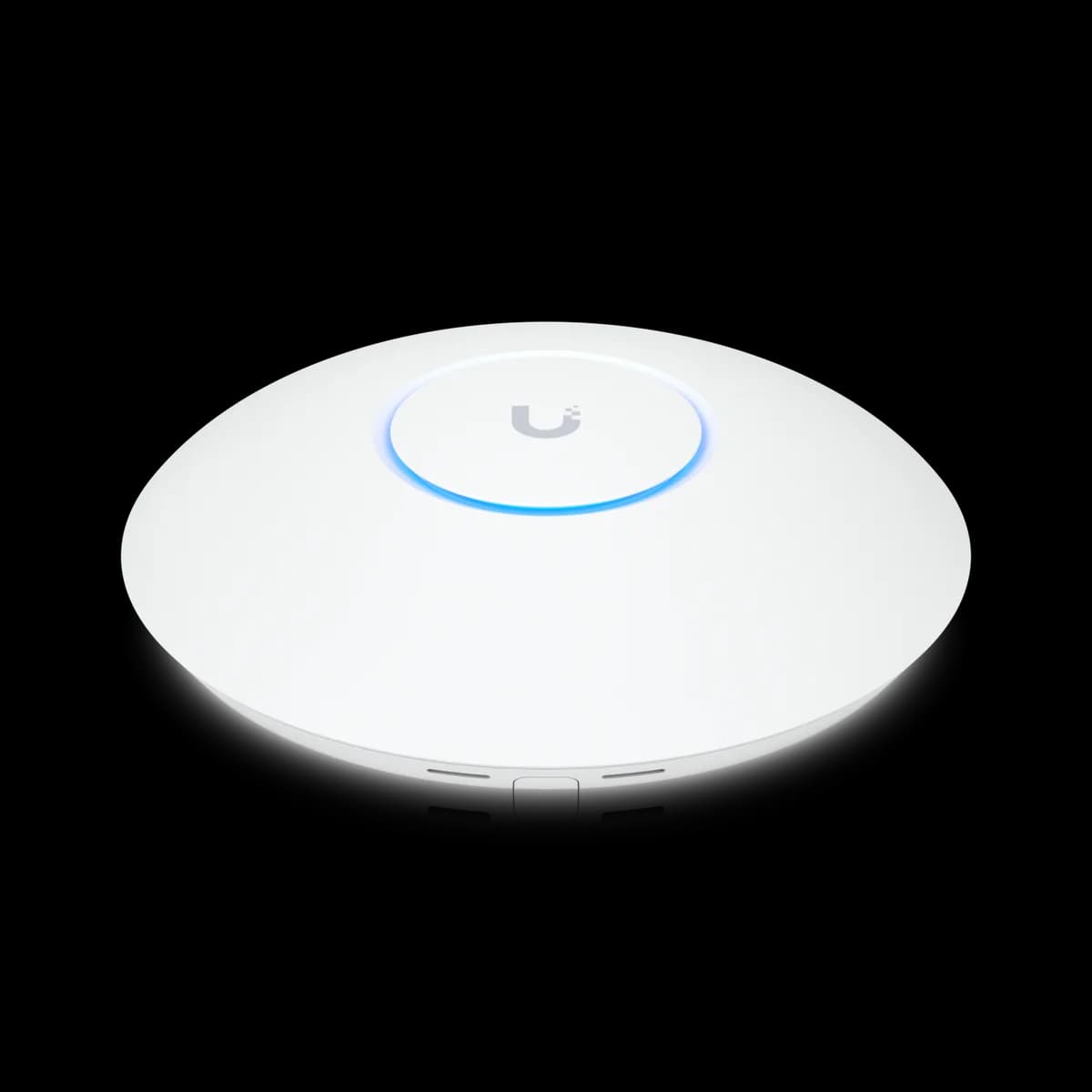
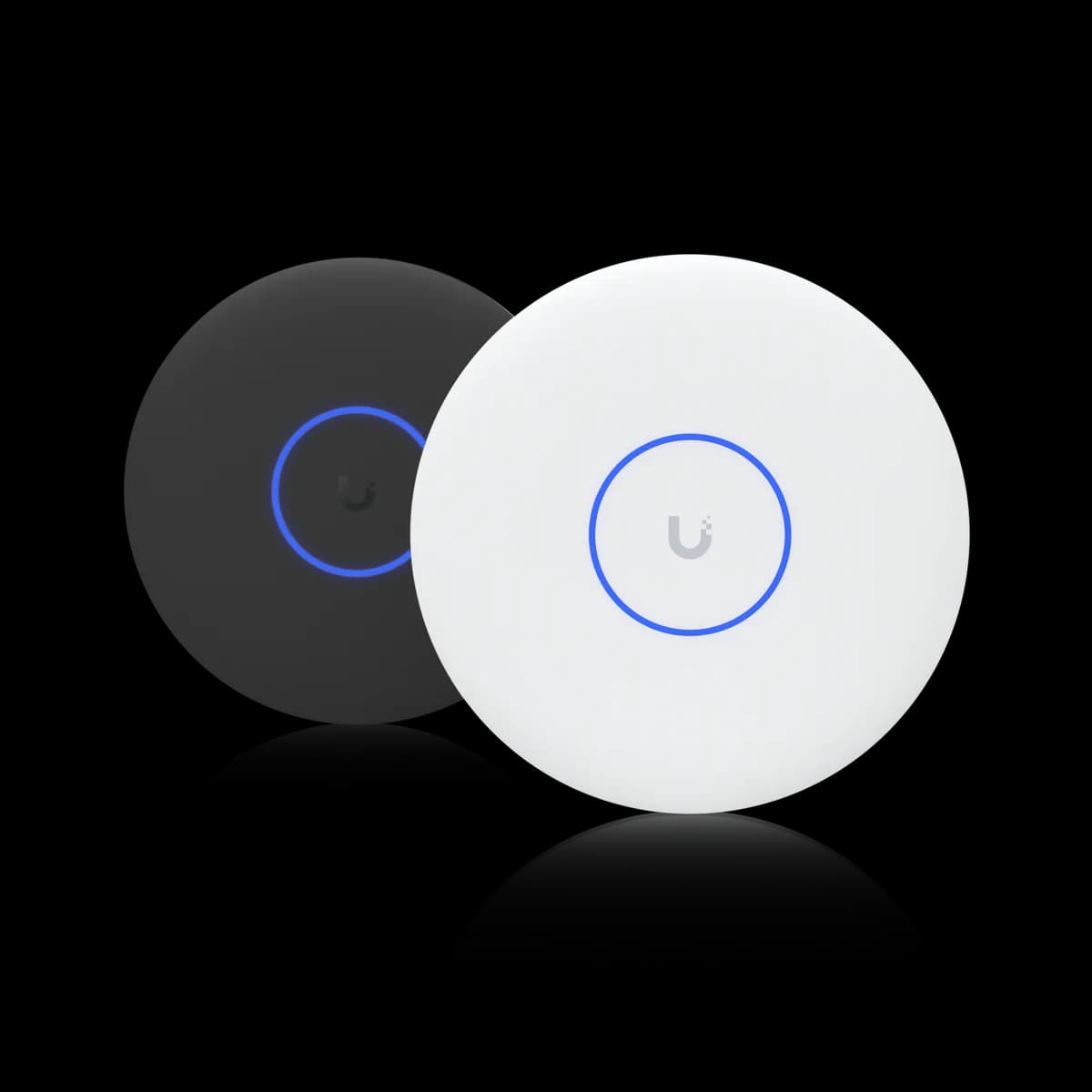
Comparison

UniFi U7 Pro Max vs U7 Pro XGS: $20 for 10 GbE

Same eight-stream tri-band Wi-Fi 7 ratings, spectral analysis, 500+ clients, and 160 m². The $299 U7 Pro XGS adds a 10 GbE uplink and needs PoE++ at 29 W.

Should I buy the UniFi U7 Pro Max or the U7 Pro XGS?

The U7 Pro XGS ($299) is the U7 Pro Max ($279) with one addition and one new requirement. Both carry eight-stream tri-band Wi-Fi 7 radios with matching ratings, including 500+ clients and 160 m², and Ubiquiti lists real-time spectral analysis on both. The XGS swaps the 1/2.5 GbE uplink for a 10 GbE port, but it draws 29 W and requires PoE++ (802.3bt) where the U7 Pro Max runs on PoE+ at 25 W. Buy the XGS only if the port behind it supplies PoE++ at 5 or 10 GbE. Buy the U7 Pro Max for a PoE+ switch, or for a ceiling void hotter than the XGS's 40 °C limit.

Spec Comparison

SpecUniFi U7 Pro MaxUniFi U7 Pro XGS
Wi-Fi StandardWi-Fi 7 (802.11be)Wi-Fi 7 (802.11be)
BandsTri-band (2.4 + 5 + 6 GHz)Tri-band (2.4 + 5 + 6 GHz)
6 GHz Rate5.8 Gbps (BW320)5.8 Gbps (BW320)
5 GHz Rate8.6 Gbps (BW240)8.6 Gbps (BW240)
2.4 GHz Rate688 Mbps (BW40)688 Mbps (BW40)
Spatial Streams88
5 GHz MIMO4×44×4
Uplink Port(1) 1/2.5 GbE RJ45(1) 10 GbE RJ45
Power MethodPoE+PoE++
Max Power Draw25 W29 W
Max Clients500+500+
Coverage Area160 m² (1,750 ft²)160 m² (1,750 ft²)
Dimensions⌀206 × 46 mm⌀215 × 32.5 mm
Weight680 g800 g
Max TX Power6 GHz 23 dBm · 5 GHz 29 dBm · 2.4 GHz 23 dBm6 GHz 24 dBm · 5 GHz 29 dBm · 2.4 GHz 23 dBm
5 GHz Antenna Gain6 dBi6 dBi
6 GHz Antenna Gain5.9 dBi6 dBi
Operating Temp-30 to 50 °C (-22 to 122 °F)-30 to 40 °C (-22 to 104 °F)
Real-Time Spectral AnalysisYesYes

Pricing & Positioning

What does $20 buy? The U7 Pro Max lists at $279, the U7 Pro XGS at $299. The extra buys a 10 GbE RJ45 uplink in place of 1/2.5 GbE and no wireless upgrade: the radio ratings match, and both list real-time spectral analysis. The XGS also draws 29 W (PoE++) against the Max's 25 W (PoE+), a different port class. (U7 Pro XGS specs)

Of the nine APs this site tracks, these are the two with exactly eight streams — the top of the mainstream Wi-Fi 7 ladder. The U7 Pro Max arrived in mid-2024 as the high-density model; the U7 Pro XGS followed in the March 2025 Pro XG lineup as its 10 GbE counterpart. Ubiquiti priced the step at $20, which is small enough that the real cost is on the switch side.

The XGS is not faster over the air, does not cover more, and does not carry more clients. It lifts the uplink ceiling to 10 GbE, and it asks for a PoE++ port to do it. If the port is there, $20 is trivial; if it is not, the Max is the only one of the two that belongs on the port you have. How to choose a UniFi access point covers the tiers below, and the Access Points hub lists the family.

The Same Eight-Stream Radio

Is the XGS faster over the air? No. Both are tri-band Wi-Fi 7 with eight streams: 4×4 on 5 GHz at 8.6 Gbps (BW240), 2×2 on 6 GHz at 5.8 Gbps (BW320), and 2×2 on 2.4 GHz, rated for 500+ clients and 160 m² (1,750 ft²). The U7 Pro XGS's wireless ratings are the U7 Pro Max's. (U7 Pro Max specs)

Every rated throughput, stream, client, and coverage figure matches, and both transmit at up to 29 dBm on 5 GHz. Two 6 GHz figures differ slightly: transmit power is 24 dBm on the XGS against 23 dBm, and antenna gain is 6 dBi against 5.9 dBi. In a dense room the U7 Pro Max pairs two-stream clients on its 4×4 5 GHz radio and steers signal with four antennas, under a 500+ client rating. The U7 Pro XGS does the same. If the question is whether eight streams are worth having at all, that is settled one tier down in U7 Pro vs U7 Pro Max.

The physical unit differs more than the radio does. The XGS is wider and thinner, at ⌀215 × 32.5 mm and 800 g against the U7 Pro Max's ⌀206 × 46 mm and 680 g. It ships in black as well as white. It also carries a lower operating limit: 40 °C against 50 °C. In a hot ceiling void that last figure can decide the matchup on its own.

Does the Max's port hold it back? More than on any other of the nine APs tracked here. The U7 Pro Max carries 14.4 Gbps of rated 5 GHz and 6 GHz capacity behind one 2.5 GbE port. The U7 Pro XGS's 10 GbE port lifts that ceiling when the port behind it runs at 5 or 10 GbE with PoE++. (U7 Pro XGS specs)

The eight-stream tier is where a 2.5 GbE uplink matters most, because the radio's aggregate is so far above the wire. A room full of Wi-Fi 7 clients on 320 MHz 6 GHz channels, plus a 4×4 5 GHz radio at full load, can present more than 2.5 Gbps to the port. At that point the U7 Pro Max is uplink-bound while it still has airtime to spare. The U7 Pro XGS's 10 GbE RJ45 port negotiates 10, 5, 2.5, or 1 GbE and removes that limit. A full-length 10 GbE run wants Cat6A, and on older cable the link can settle at 5 or 2.5 GbE.

The switch is the constraint. Most UniFi PoE switches put 10 GbE on SFP+ uplinks, which carry no PoE. The USW Pro Max 24 PoE, for instance, has 2.5 GbE PoE ports and 10 GbE only on SFP+. Fed from the switch alone, the XGS therefore needs one of the few UniFi switches with 10 GbE PoE++ RJ45 ports. The $499 Pro XG 8 PoE is one: all eight of its 10 GbE ports are PoE++, on a 155 W budget. Five XGS units at their 29 W maximum would take 145 W of it.

For a single AP, Ubiquiti also sells a $39 10G PoE++ Adapter (60W) for a port that supplies no PoE++ of its own. It is an 802.3bt injector, and the store describes it as providing a multi-gigabit LAN connection. Behind a 2.5 GbE PoE++ port the XGS runs at the U7 Pro Max's uplink speed. UniFi uplinks and aggregation covers SFP+ uplinks and 2.5 GbE at the access edge. How to choose a UniFi switch weighs port count, PoE budget, and Layer 3 on the 1 and 2.5 GbE switches this site tracks.

PoE++: The Real Gate

What powers each? The U7 Pro Max draws up to 25 W on PoE+ (802.3at). The U7 Pro XGS draws up to 29 W and Ubiquiti lists it as PoE++ (802.3bt) — one of two APs tracked here that need it, alongside the 43 W E7. A PoE+ port that runs the Max is below the XGS's specified supply. (U7 Pro XGS specs)

Four watts does not sound like a class change, but 802.3at guarantees only 25.5 W at the powered device once cable loss is taken out, and the XGS's 29 W ceiling sits above that. Ubiquiti lists the XGS as PoE++, which makes it a different purchase from the U7 Pro Max on the switch side as well as the AP side. PoE budget planning covers 802.3at against 802.3bt budgets and what a mixed rack of APs adds up to.

Some UniFi switches do carry PoE++ ports. The USW Pro Max 24 PoE has PoE++ on all eight of its 2.5 GbE ports and on eight of its 1 GbE ports. A PoE++ port and a 10 GbE port are not always the same port, however, and the XGS needs both to deliver everything you paid for. On one of that switch's 2.5 GbE ports the XGS powers up and links at 2.5 GbE. Check the exact port before buying. If PoE+ is all the closet offers, the U7 Pro Max is the answer. The U7 Pro XG is the way to get 10 GbE on PoE+ at the six-stream tier, as U7 Pro vs U7 Pro XG explains.

Spectral Analysis: A Tie

Do both scan the spectrum? Yes. Ubiquiti's spec sheets list Real-Time Spectral Analysis on both the U7 Pro Max and the U7 Pro XGS. Its store describes a dedicated spectral scanning engine on the first and a dedicated spectral scanning radio on the second. Ubiquiti lists it on neither six-stream model, the U7 Pro or the U7 Pro XG. (U7 Pro Max specs)

It is easy to read the XGS's launch material as if spectral scanning were new to it, because Ubiquiti's Pro XG announcement sets the XGS against the six-stream U7 Pro XG, which has none. Against the U7 Pro Max the feature is a tie. Scanning hardware that is separate from the client-serving radios lets an AP listen for interference without pausing service. In an office block or a venue where neighboring networks crowd the bands, that is useful on either model.

A noisy spectrum is therefore a reason to buy at the eight-stream tier, and it says nothing about which of these two to choose. That earlier decision is the subject of U7 Pro vs U7 Pro Max. Between the U7 Pro Max and the U7 Pro XGS, the uplink, the power class, and the ceiling temperature decide it.

Who Should Buy Which

The rated speeds, streams, and coverage are identical, so this is a question about the port the AP plugs into and, in a hot ceiling void, the XGS's 40 °C limit. PoE++ on a 5 or 10 GbE port is the XGS. Anything else is the U7 Pro Max.

Buy the U7 Pro XGS if:

  • Your switch has PoE++ (802.3bt) on a 10 GbE port. That is the configuration in which every part of the $299 is used.
  • The AP must never be uplink-bound. Eight streams behind 2.5 GbE is the tightest wire-to-air ratio of the nine APs tracked here; 10 GbE relieves it.
  • You want black. The US store lists the XGS in black or white, and the U7 Pro Max in white only.

Buy the U7 Pro Max if:

  • Your switch is PoE+ (802.3at). Ubiquiti specifies PoE++ for the XGS; the Max runs on any PoE+ port.
  • Your PoE ports top out at 2.5 GbE. Behind that port the XGS negotiates down to the Max's uplink anyway.
  • The ceiling runs hot. The Max's 50 °C rating beats the XGS's 40 °C.
  • It is a home. $20 plus a switch upgrade buys nothing a household will notice, and the spectral analysis is the same.

Deciding across the range? Start with how to choose a UniFi access point, see the six-stream 10 GbE option in U7 Pro vs U7 Pro XG, or browse the Access Points hub.

Frequently Asked Questions

One addition and one requirement. The U7 Pro XGS ($299) replaces the U7 Pro Max's 1/2.5 GbE uplink with a 10 GbE RJ45 port, but it draws 29 W and requires PoE++ (802.3bt) where the U7 Pro Max ($279) draws 25 W on PoE+ (802.3at). The Wi-Fi 7 radio ratings are identical: eight streams, 4×4 on 5 GHz, 6 GHz at 5.8 Gbps, 500+ clients, 160 m². Ubiquiti lists real-time spectral analysis on both.

Yes. Ubiquiti lists the U7 Pro XGS's power method as PoE++ (802.3bt) with a maximum draw of 29 W. It is one of two of the nine ceiling APs this site tracks that require PoE++, alongside the 43 W E7; the U7 Pro Max, at 25 W, runs on PoE+ (802.3at). A PoE+ port that powers the Max is below the XGS's specified supply.

Not over Wi-Fi — the two share the same eight-stream tri-band radio ratings. The XGS is faster on the wire, behind a 5 or 10 GbE switch port, where its 10 GbE uplink carries what the Max's 2.5 GbE port cannot. On a 2.5 GbE port the two APs have the same uplink.

Yes. Ubiquiti's specification tables list Real-Time Spectral Analysis on both models, and its store describes a dedicated spectral scanning engine on the U7 Pro Max and a dedicated spectral scanning radio on the U7 Pro XGS. Ubiquiti lists it on neither six-stream model, the U7 Pro or the U7 Pro XG, so the feature separates the eight-stream tier from the six-stream tier, not these two from each other.

One with PoE++ (802.3bt) on a 10 GbE RJ45 port, if you want both the power and the uplink the XGS is built for. Today that narrows it to the few UniFi switches with 10 GbE PoE++ RJ45 ports, such as the Pro XG 8 PoE, or to a multi-gig port fed through Ubiquiti's 10G PoE++ Adapter (60W). On a 2.5 GbE PoE++ port the XGS works but negotiates down to the Max's uplink speed; a PoE+ port falls short of the PoE++ supply Ubiquiti specifies. Check the specific port, since PoE++ and 10 GbE are not always on the same one.