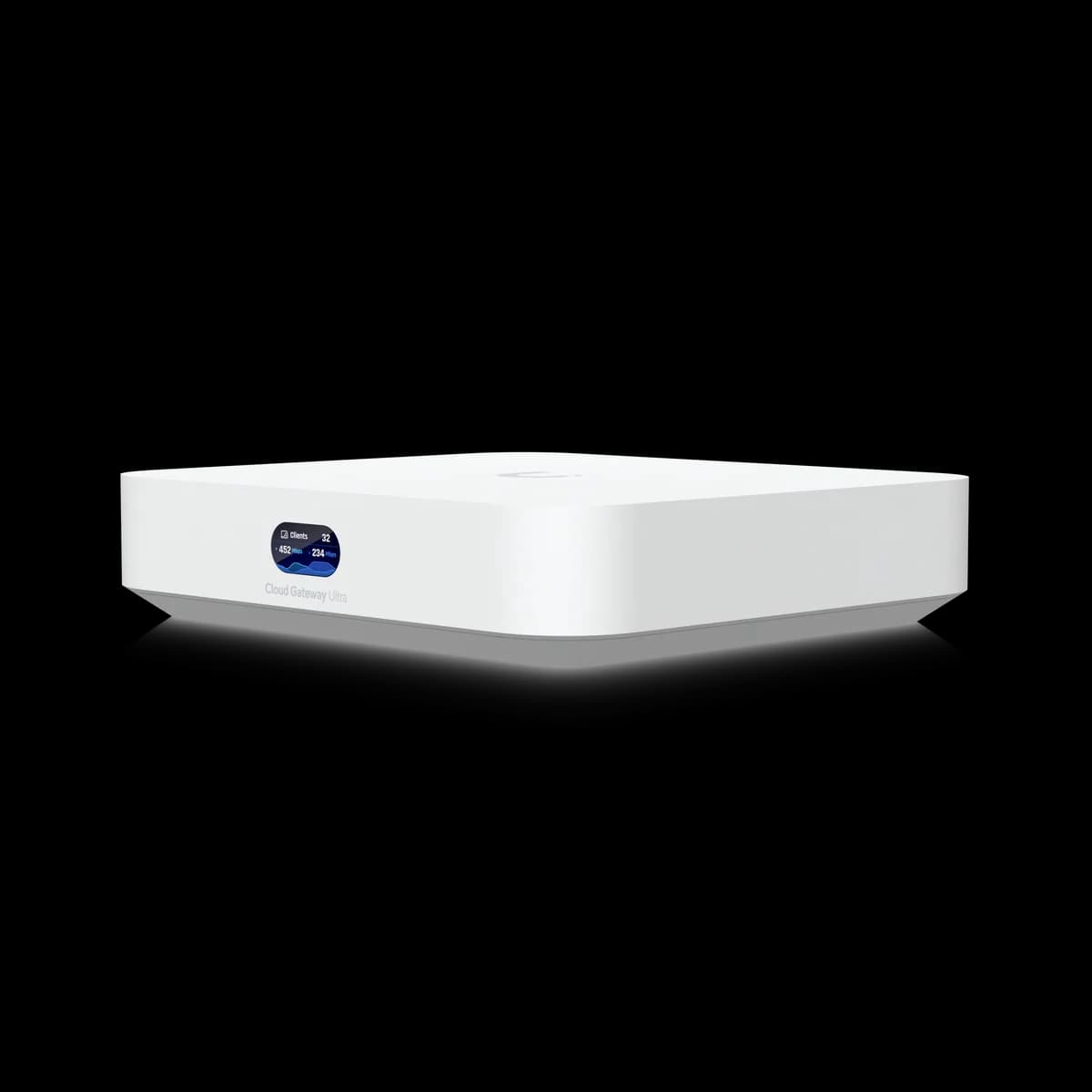
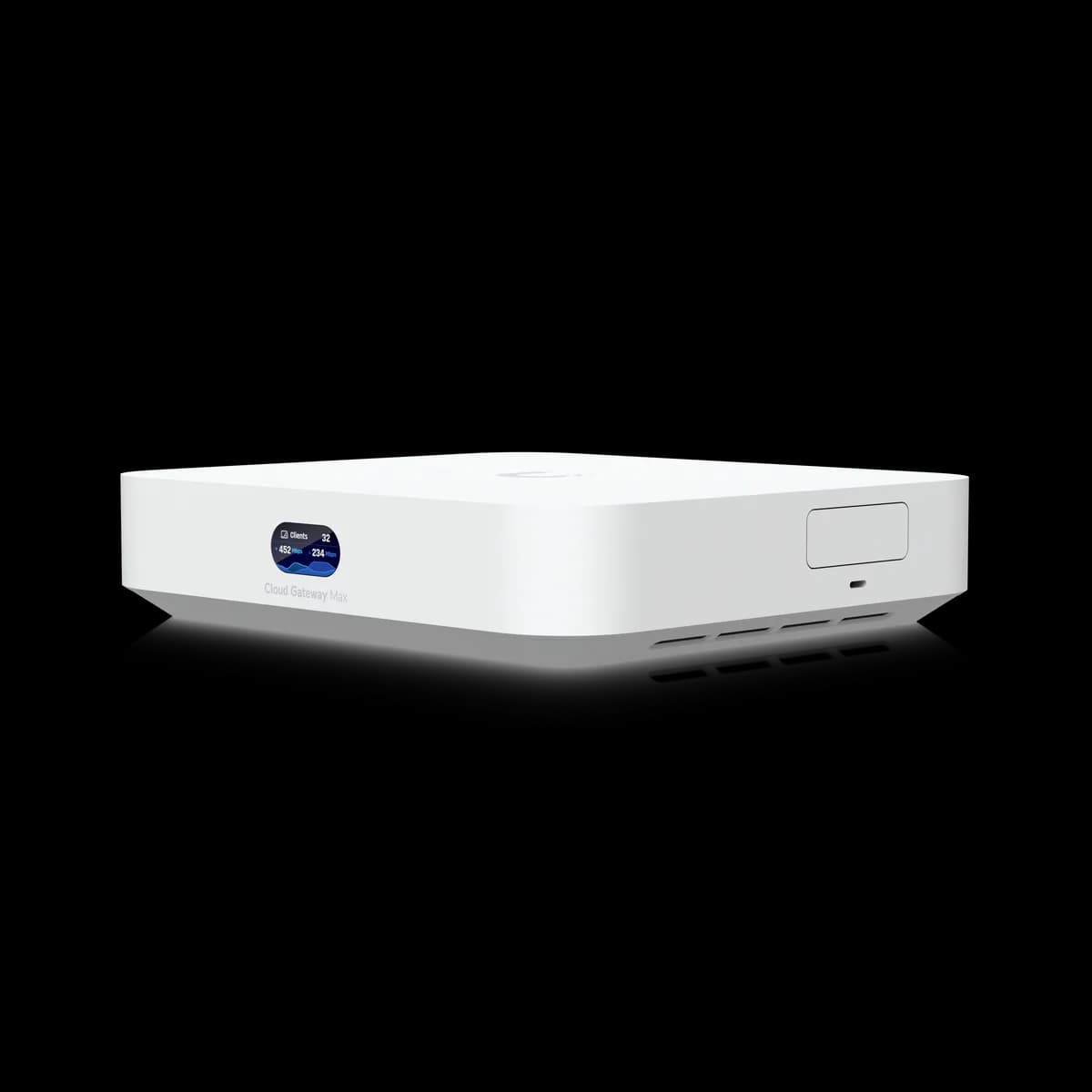
Comparison

UniFi Cloud Gateway Ultra vs Max: $150 Apart

The $129 Cloud Gateway Ultra and the $279 Cloud Gateway Max share a processor and a case. The Max doubles IPS, puts every port at 2.5 GbE, and records Protect.

Should I buy the UniFi Cloud Gateway Ultra or the Cloud Gateway Max?

The Cloud Gateway Max ($279) is the Cloud Gateway Ultra ($129) with three changes: IDS/IPS rises from 1 Gbps to 2.3 Gbps, the four LAN ports go from 1 GbE to 2.5 GbE, and an NVMe slot lets it record UniFi Protect cameras that the Ultra cannot record at all. Everything else matches, including the processor, the 3 GB of memory, the case, and the 30+ device and 300+ client ratings. Buy the Ultra for a gigabit line and 1 GbE devices. Buy the Max if the network is 2.5 GbE, the line is faster than a gigabit, or cameras are coming.

Spec Comparison

SpecUniFi Cloud Gateway UltraUniFi Cloud Gateway Max
ProcessorQuad-core ARM Cortex-A53 @ 1.5 GHzQuad-core ARM Cortex-A53 @ 1.5 GHz
System Memory3 GB3 GB
On-Board Storage16 GB
WAN Port(1) 2.5 GbE RJ45(1) 2.5 GbE RJ45 (default)
LAN Ports(4) GbE RJ45(5) 2.5 GbE RJ45 total, one used as WAN
IDS/IPS Throughput1 Gbps2.3 Gbps
Form FactorCompact desktopCompact desktop
Max UniFi Devices30+30+
Max Clients300+300+
Dimensions141.8 × 127.6 × 30 mm141.8 × 127.6 × 30 mm
Weight520 g460 g (519 g with SSD)
Operating Temp-10 to 40 °C-10 to 40 °C
Max Power Draw6.2 W16.1 W
Protect StorageSelectable NVMe SSD up to 2 TB
Protect Cameras(15) HD, (8) 2K, (5) 4K

Pricing & Positioning

What does $150 buy? Three things, on a box that is otherwise the same: 2.3 Gbps of IDS/IPS against 1 Gbps, four 2.5 GbE LAN ports where the Cloud Gateway Ultra has 1 GbE, and a slot for an NVMe SSD up to 2 TB so the Cloud Gateway Max can record cameras. (Cloud Gateway Max specs)

These two are the closest pair among the eight gateways this site tracks, sharing a quad-core A53 at 1.5 GHz, 3 GB of memory, the same 141.8 × 127.6 × 30 mm case, and the same 0.96-inch status display. Ubiquiti even rates them identically for scale, at 30+ UniFi devices and 300+ simultaneous users.

What separates them is the speed of everything downstream of the WAN port and whether the gateway can hold footage. If neither is a constraint, the cheaper unit is the whole answer. How to choose a UniFi gateway sets both against the rest of the range.

The LAN Ports: 1 GbE or 2.5 GbE

Faster LAN ports? Yes, and it is the difference most buyers will feel. The Cloud Gateway Max carries five 2.5 GbE RJ45 ports, one used as WAN. The Cloud Gateway Ultra pairs a 2.5 GbE WAN with four 1 GbE LAN ports. (Cloud Gateway Max specs)

Both accept a multi-gig line, because both WAN ports run at 2.5 GbE. The difference begins one hop later. The Ultra hands that traffic to gigabit ports and the Max does not, so a 2 Gbps plan reaches a single device on the Max and never does on the Ultra.

This matters more over time than it reads. A switch, a NAS, or a Wi-Fi 7 access point on a 2.5 GbE uplink is held to a gigabit behind the Ultra. That is the port most people wish they had bought differently. UniFi uplinks and aggregation covers where 2.5 GbE at the edge pays off.

For a household on gigabit fibre with gigabit devices, none of this is reachable, and the Ultra's four ports are simply four ports.

IDS/IPS: 1 Gbps Against 2.3

Which inspects more? The Cloud Gateway Max, rated at 2.3 Gbps of IDS/IPS against the Cloud Gateway Ultra's 1 Gbps — both from the same quad-core A53 at 1.5 GHz and 3 GB of memory. (Cloud Gateway Ultra specs)

IDS/IPS throughput is the ceiling that applies once threat inspection is switched on, and the Ultra's sits exactly where a symmetrical gigabit line does. That is comfortable today and has no headroom if the line is upgraded, which is the argument for the Max even on a network that is otherwise gigabit.

A common misreading is that the Ultra's 2.5 GbE WAN port implies 2.5 Gbps of inspected throughput. The port speed and the inspection rating are separate figures, and it is the smaller one that governs once IPS is on.

Protect: The Max Can Record, the Ultra Cannot

Can either record cameras? Only the Cloud Gateway Max, which takes a selectable NVMe SSD up to 2 TB and is rated for 15 HD, 8 2K, or 5 4K cameras. The Cloud Gateway Ultra has no Protect storage at all, so cameras behind it need a separate recorder or a different gateway. (Cloud Gateway Max specs)

For anyone planning Protect cameras, this line usually settles the comparison on its own, because the alternative behind an Ultra is a second box — an NVR or a gateway that can hold a drive. Protect storage sizing works through how much disk a given camera count needs.

The drive is a separate purchase on the Max, so the real figure is $279 plus an SSD. Even so, it is one device on the shelf rather than two, and the camera count it supports covers most homes.

Power Draw & Weight

More power? Yes, roughly two and a half times as much. Ubiquiti rates the Cloud Gateway Max at 16.1 W and the Cloud Gateway Ultra at 6.2 W, drawn from USB-C at 5V/5A and 5V/3A respectively, and both units are fanless. (Cloud Gateway Max specs)

Both are fanless and both run from a USB-C supply, so this is a difference in what the adapter has to deliver rather than in how the unit behaves. Neither will be the thing that shows up on an electricity bill.

Weight runs the other way, which is a small surprise. The Ultra is 520 g and the Max 460 g without an SSD, rising to 519 g with one fitted. Both share the same case dimensions and the same -10 to 40 °C operating range.

Who Should Buy Which

The device ratings are identical, so this is a question about port speed, line speed, and cameras.

Buy the Cloud Gateway Max if:

  • Your network is 2.5 GbE, or heading there. Four 2.5 GbE LAN ports are the reason to spend the $150.
  • Your line is faster than a gigabit. 2.3 Gbps of IPS leaves room where the Ultra's 1 Gbps does not.
  • Cameras are coming. The NVMe slot makes it a recorder; the Ultra cannot be one.

Buy the Cloud Gateway Ultra if:

  • Gigabit is the line and the devices. Nothing above is reachable, and $150 buys a lot of other hardware.
  • Draw matters. At 6.2 W it is the lightest load of the eight gateways here.
  • A separate recorder is already planned. An NVR or a rack gateway makes the Max's slot redundant.

Looking at the other $279 option? Cloud Gateway Max vs Cloud Gateway Fiber spends the same money on 10G and PoE instead.

Frequently Asked Questions

Three things. The Cloud Gateway Max ($279) rates 2.3 Gbps of IDS/IPS against 1 Gbps, gives all five of its RJ45 ports 2.5 GbE where the Ultra ($129) has a 2.5 GbE WAN and four 1 GbE LAN ports, and takes an NVMe SSD up to 2 TB for UniFi Protect. Processor, memory, case, and the 30+ device and 300+ client ratings are the same.

No. Ubiquiti publishes no Protect storage for the Cloud Gateway Ultra and no camera counts. Cameras behind one need a separate NVR or a gateway with a drive. The Cloud Gateway Max takes an NVMe SSD up to 2 TB and is rated for 15 HD, 8 2K, or 5 4K cameras.

It depends on the ports. If devices and line are gigabit, the Ultra reaches every ceiling the Max does and the money is better spent elsewhere. If the network is 2.5 GbE, the line is faster than a gigabit, or Protect cameras are planned, the Max answers all three and the Ultra answers none.

Yes. Both list a quad-core ARM Cortex-A53 at 1.5 GHz with 3 GB of memory, and both are rated for 30+ UniFi devices and 300+ simultaneous users. The IDS/IPS ratings still differ, at 1 Gbps and 2.3 Gbps.

Ubiquiti rates the Cloud Gateway Ultra at 6.2 W and the Cloud Gateway Max at 16.1 W. Both are fanless and USB-C powered, at 5V/3A and 5V/5A. Both are rated to operate from -10 to 40 °C.