Comparison

UniFi Dream Router vs Dream Router 7

The $279 Dream Router 7 brings Wi-Fi 7, 2.5 GbE ports and 2.3 Gbps of IPS to the $199 Dream Router's all-in-one shape — but halves the PoE budget.

Should I buy the UniFi Dream Router or the Dream Router 7?

The Dream Router 7 ($279) is the newer machine in almost every direction: tri-band Wi-Fi 7 against dual-band Wi-Fi 6, 160 m² of rated coverage against 140 m², 2.5 GbE ports and a 10G SFP+ against gigabit, and 2.3 Gbps of IDS/IPS against 1 Gbps. It doubles the client rating to 300+. The Dream Router ($199) keeps two advantages that decide some installs: a 40 W PoE budget across two ports against 15.4 W on one, and a 128 GB SSD for Protect where the 7 records to microSD.

Spec Comparison

SpecUniFi Dream RouterUniFi Dream Router 7
ProcessorDual-core ARM Cortex-A53 @ 1.35 GHzQuad-core ARM Cortex-A53 @ 1.5 GHz
On-Board Storage128 GB SSD
WAN Port(1) GbE RJ45(1) 10G SFP+ + (1) 2.5 GbE RJ45 (default)
LAN Ports(5) GbE RJ45, (2) with PoE(4) 2.5 GbE RJ45, one with PoE + (1) 10G SFP+ total; the SFP+ is a default WAN port
PoE Output40 W total budget (15.4 W max/port)15.4 W total budget
Integrated Wi-FiWi-Fi 6 — 2.4 Gbps (5 GHz) + 600 Mbps (2.4 GHz)Wi-Fi 7 — 5.7 Gbps (6 GHz) + 4.3 Gbps (5 GHz) + 688 Mbps (2.4 GHz)
IDS/IPS Throughput1 Gbps2.3 Gbps
Form FactorCompact desktopCompact desktop
Max UniFi Devices20+30+
Max Clients150+300+
Protect Cameras(5) HD, (2) 2K, (1) 4K(5) HD, (2) 2K, (1) 4K
Dimensions⌀110 × 184.1 mm⌀110 × 184.1 mm
Weight1.2 kg1.1 kg
Operating Temp-10 to 45 °C-10 to 40 °C
Max Power Draw19.37 W (excl. PoE output)26 W (excl. PoE output)
System Memory3 GB
Protect StoragePre-installed 64 GB microSD (microSD slot)
Coverage Area160 m² (1,750 ft²)

Pricing & Positioning

What does $80 add? A generation of everything. The Dream Router 7 carries tri-band Wi-Fi 7, 2.5 GbE ports with a 10G SFP+, and 2.3 Gbps of IDS/IPS, where the Dream Router has dual-band Wi-Fi 6, gigabit ports, and 1 Gbps. (Dream Router 7 specs)

Both are the same idea: one desktop box that routes, serves Wi-Fi, switches a few ports, powers a device or two, and records a camera. Of the eight gateways this site tracks, these two are the only ones with a radio inside.

The question is not whether the newer unit is better, because on most rows it plainly is. It is whether the two things the older one does better — PoE and Protect storage — matter in your install. How to choose a UniFi gateway places both against the gateways that have no Wi-Fi at all.

Wi-Fi 6 or Wi-Fi 7

How much better is the Wi-Fi? It adds a band. The Dream Router 7 is tri-band Wi-Fi 7, rated 5.7 Gbps on 6 GHz, 4.3 Gbps on 5 GHz, and 688 Mbps on 2.4 GHz. The Dream Router is dual-band Wi-Fi 6 at 2.4 Gbps on 5 GHz and 600 Mbps on 2.4 GHz. (Dream Router specs)

The 6 GHz radio is the real addition, and Wi-Fi 6E and Wi-Fi 7 clients are the ones that can reach it. On a recent phone or laptop that band is clean spectrum the older unit simply does not offer, which is the strongest argument for the newer box in a busy building.

Stream counts run the other way, and it is worth knowing before assuming the newer radio wins everywhere. Ubiquiti lists the Dream Router at 4 × 4 on both of its bands and the Dream Router 7 at 2 × 2 on all three, so the older unit puts more streams on 5 GHz even though its ceiling is lower.

Rated coverage still favours the newer one, at 160 m² against 140 m². Neither radio can be repositioned, so in both cases the coverage is wherever the router has to sit — which is the case for a separate access point in a larger home.

Ports & Inspection

Faster ports? Substantially. The Dream Router 7 carries four 2.5 GbE RJ45 and a 10G SFP+, with a 10G SFP+ and a 2.5 GbE as its default WAN. The Dream Router carries five gigabit ports behind a 1 GbE WAN. (Dream Router specs)

A gigabit WAN is the hard limit on the older unit, so a faster line cannot be used no matter what else changes. The newer one takes a multi-gig line on copper or fibre, and its 2.3 Gbps of IDS/IPS means inspection stays on above a gigabit rather than becoming the next ceiling.

Client capacity moves with it. Ubiquiti rates the Dream Router 7 for 300+ simultaneous users and 30+ UniFi devices, against 150+ and 20+. For a household with a few dozen connected things, either is sufficient, and the gap shows in a busy office or a rental full of guest phones.

Where the Dream Router Still Wins

Does the older one win anywhere? Two rows. The Dream Router lists a 40 W PoE budget across two ports, where the Dream Router 7 lists 15.4 W on one. And it records Protect to a 128 GB SSD, where the 7 uses a pre-installed 64 GB microSD. (Dream Router specs)

Forty watts across two ports runs two cameras, or a camera and an access point, directly from the router. Fifteen watts on one port runs a single G6 Bullet at 9.9 W and nothing beside it, so a second powered device behind the newer unit means a PoE switch or an injector.

The storage difference is smaller than it looks, because both are rated for the same camera count: 5 HD, 2 2K, or 1 4K. An SSD is the better medium for continuous recording, but the ceiling either one supports is the same, and Protect storage sizing covers what a given retention window actually needs.

One more row favours the older unit. It is rated to 45 °C against 40 °C, which matters in a warm cupboard or a loft.

Draw & Footprint

Which draws more? The Dream Router 7, at 26 W excluding PoE against the Dream Router's 19.37 W. It is also marginally lighter, at 1.1 kg against 1.2 kg, and both run from a universal AC input rather than USB-C. (Dream Router specs)

Neither is a meaningful load, and both are fanless towers meant to sit in the open rather than in a cabinet. The newer unit spends its extra watts on a third radio and faster silicon, which is exactly where you would want them going.

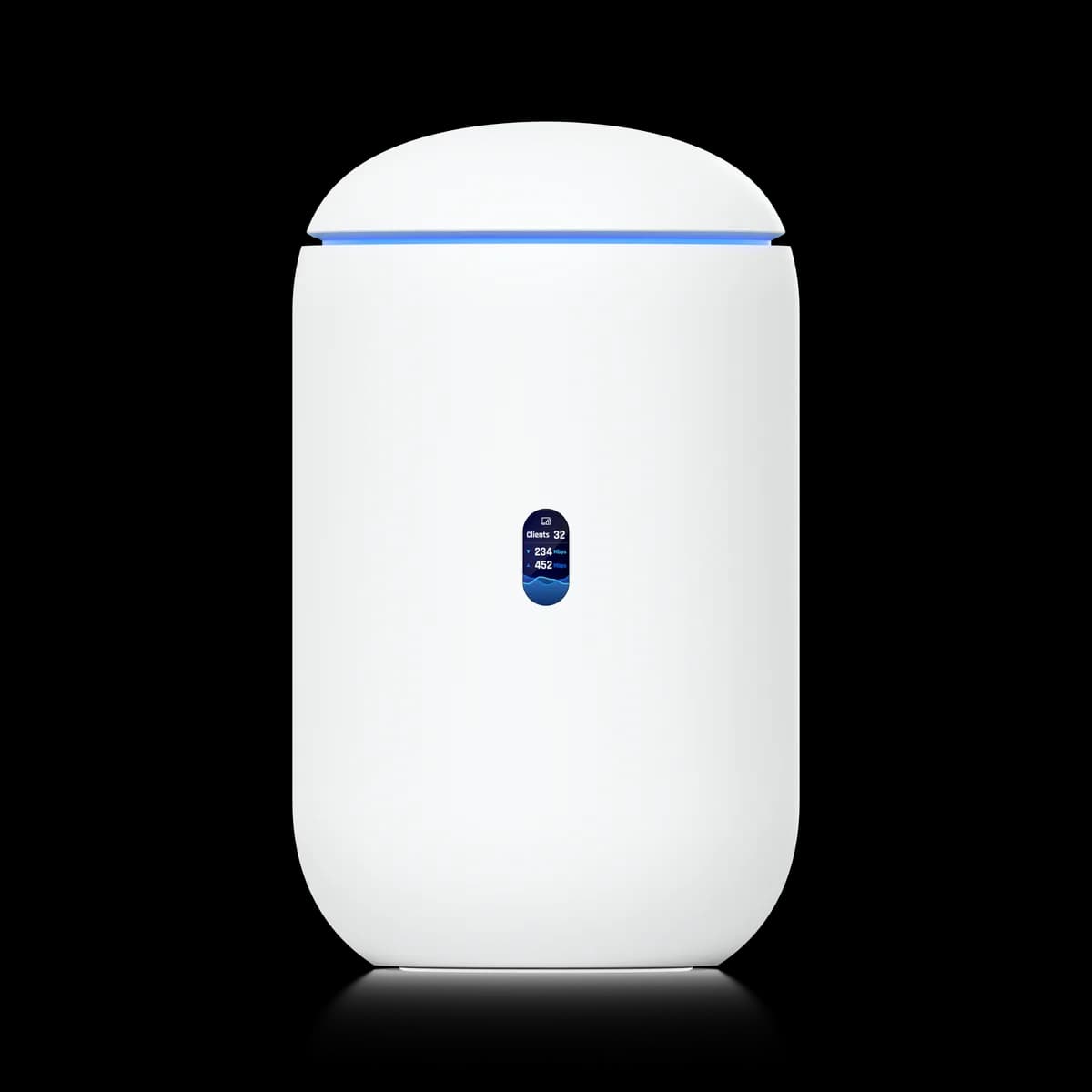
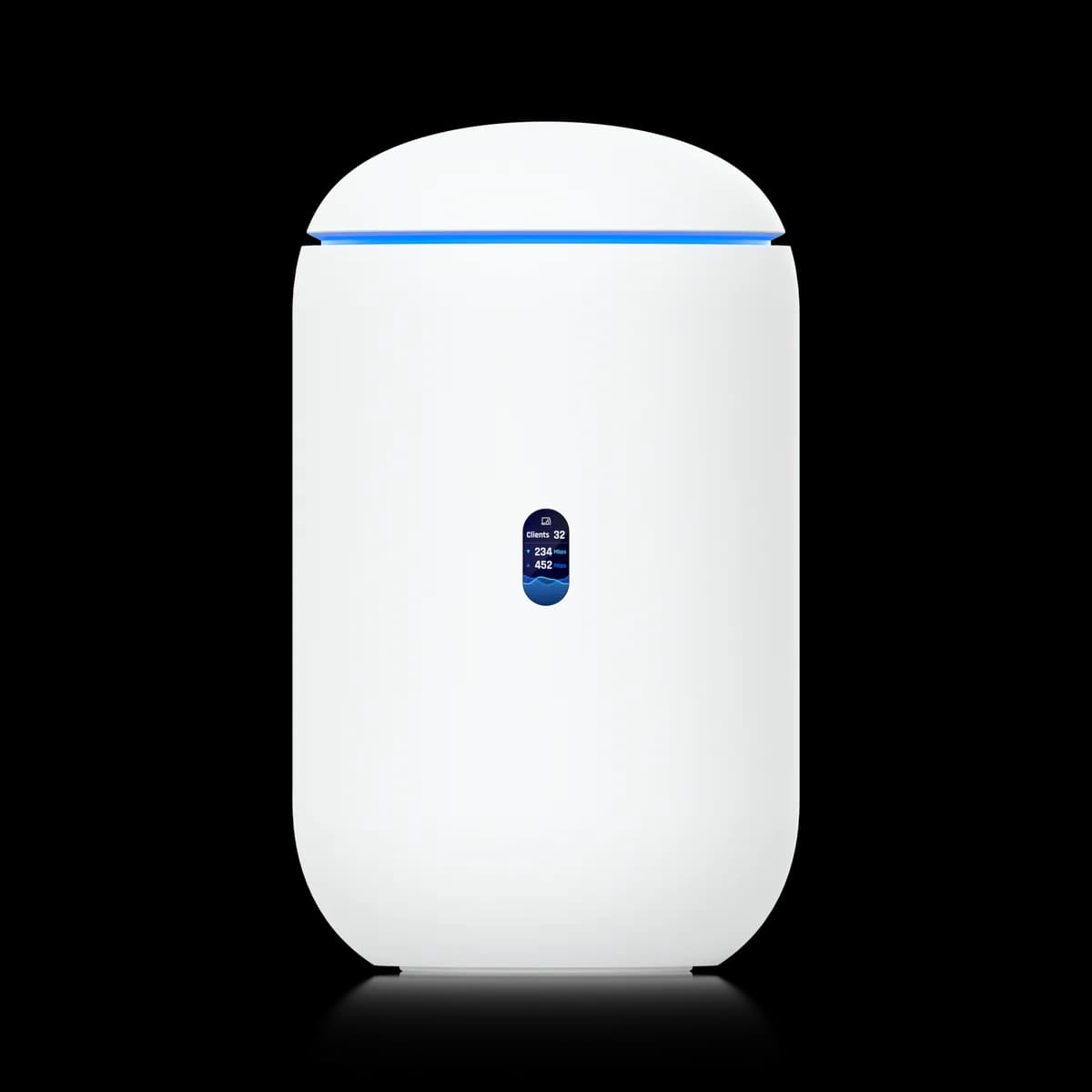
Both carry a 0.96-inch status display and both are managed through UniFi Network on-device, so day-to-day the two behave the same way.

Who Should Buy Which

The newer unit wins the spec sheet. The older one wins on powered devices, so start there.

Buy the Dream Router 7 if:

  • Your clients are Wi-Fi 6E or Wi-Fi 7. The 6 GHz radio is the reason to buy it, and nothing else here has one.
  • Your line is faster than a gigabit. Its WAN and its 2.3 Gbps of inspection both clear that bar; the older unit's do not.
  • The network is 2.5 GbE. Four 2.5 GbE ports and a 10G SFP+ against five gigabit ports.

Buy the Dream Router if:

  • Two devices need PoE from the router. 40 W across two ports against 15.4 W on one.
  • Gigabit is the line. Nothing above it is reachable, and $80 stays in your pocket.
  • It will sit somewhere warm. Rated to 45 °C against 40 °C.

If the Wi-Fi does not need to live in the gateway, Cloud Gateway Max vs Cloud Gateway Fiber covers the radio-free pair at the same $279, and the Access Points hub has the separate-AP route.

Frequently Asked Questions

For a recent client fleet, yes. The Dream Router 7 adds a 6 GHz radio, 2.5 GbE ports with a 10G SFP+, 2.3 Gbps of IDS/IPS against 1 Gbps, and doubles the client rating to 300+. The Dream Router is the better buy only when two devices need PoE from the router itself, or when everything is gigabit anyway.

Yes, tri-band. Ubiquiti rates it at 5.7 Gbps on 6 GHz, 4.3 Gbps on 5 GHz, and 688 Mbps on 2.4 GHz, at 2 × 2 on each band, covering 160 m². Wi-Fi 6E and Wi-Fi 7 clients can use the 6 GHz band; older clients stay on 5 and 2.4 GHz.

The Dream Router lists a 40 W total budget with two PoE ports at up to 15.4 W each. The Dream Router 7 lists 15.4 W on a single port. That is the one row where the older and cheaper unit is clearly ahead.

Yes, and to the same rating: 5 HD, 2 2K, or 1 4K cameras. The Dream Router uses a built-in 128 GB SSD and the Dream Router 7 a pre-installed 64 GB microSD, with a microSD slot for replacement.

No. Ubiquiti lists the Dream Router at 4 × 4 on both 5 GHz and 2.4 GHz, and the Dream Router 7 at 2 × 2 on all three of its bands. The newer unit's advantage is the extra band and the higher rates, not the stream count.