Comparison

UniFi G6 180 vs G6 Pro 360: Which Panorama?

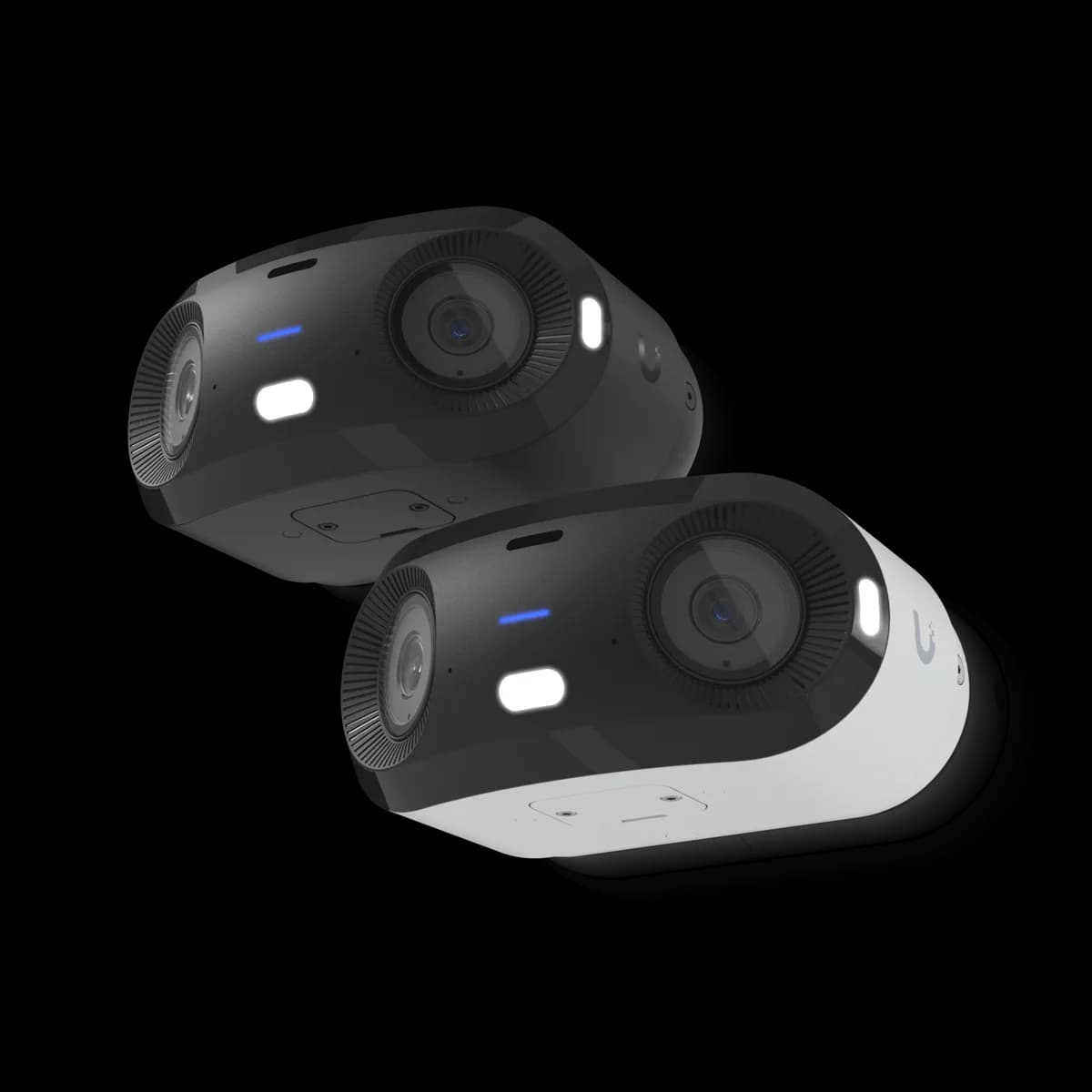
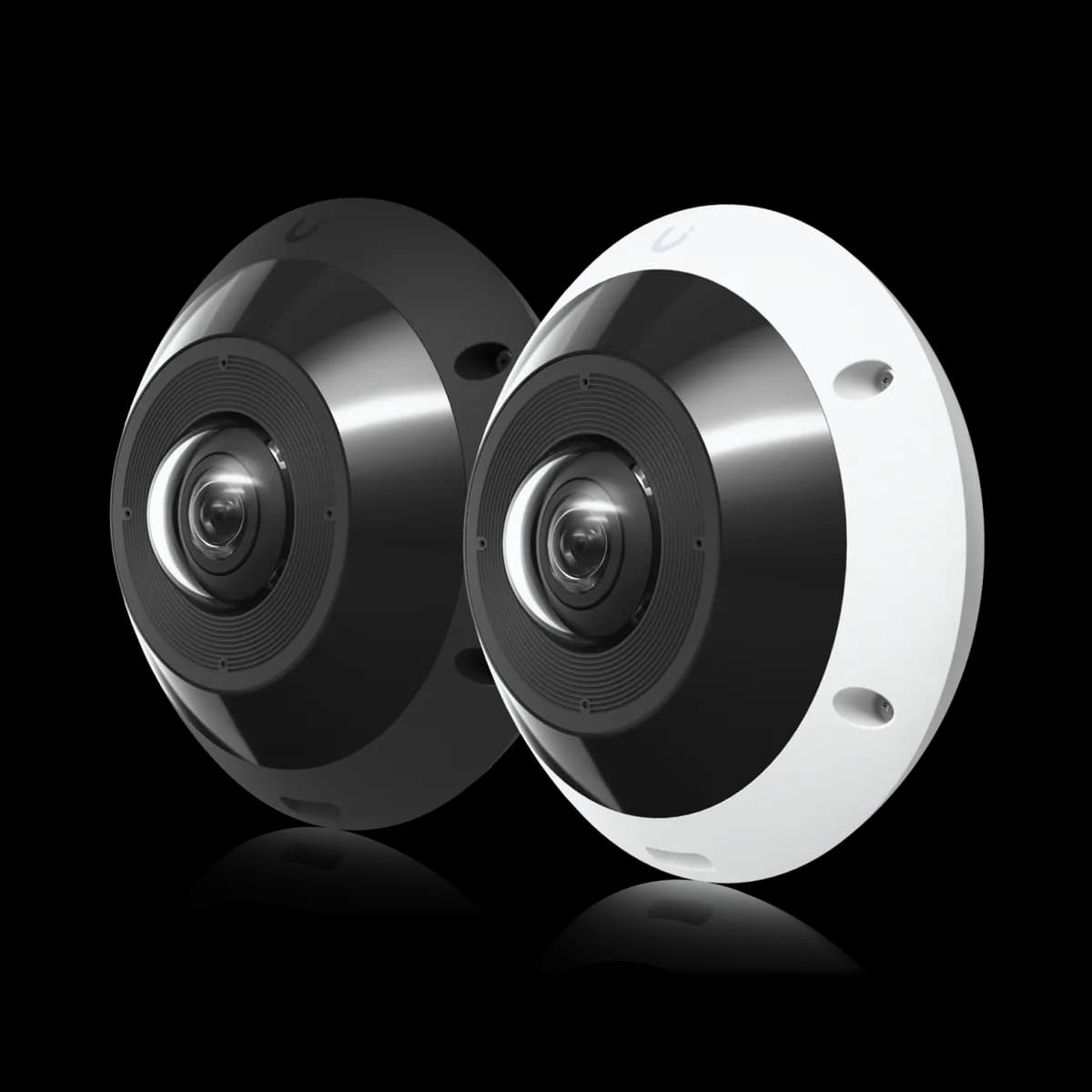
The $299 G6 180 stitches two sensors into a 16MP, 180° wall view with face and plate recognition. The $499 G6 Pro 360 is a 12MP IK10 ceiling fisheye on PoE+.

Should I buy the UniFi G6 180 or the G6 Pro 360?

Buy by mounting position. The G6 180 ($299) is a wall camera: two 1/1.8-inch sensors stitched into a 16MP 7680 × 2160 strip covering 180° × 56.7° at 20 fps, with 20 m of IR, plus face and license-plate recognition. The G6 Pro 360 ($499) is a ceiling camera: a 1/1.6-inch 12MP fisheye producing a 3504 × 3504 image of the whole room at 24 fps, with 15 m of IR in four zones, an IK10 rating, -30 °C, and person, vehicle, and animal detections only. Both need PoE+ and list two-way audio and microSD. A frontage is a G6 180 job. A shop floor is a G6 Pro 360 job.

Spec Comparison

SpecUniFi Protect G6 180UniFi Protect G6 Pro 360
Form FactorOutdoor panoramic (dual-sensor 180°)Outdoor fisheye (360°, ceiling)
Image SensorDual 1/1.8" 8MP1/1.6" 12MP
Max Resolution16MP (7680 × 2160) at 20 fps12MP (3504 × 3504) at 24 fps
Field of ViewH 180° · V 56.7°H 180° · V 180° (fisheye)
IR Night Vision20 m (65 ft); up to 40 m (130 ft) with G6 180 Enhancer15 m (50 ft), four controllable Smart IR zones
ConnectivityWired — 10/100 RJ45Wired — 10/100 RJ45
Power MethodPoE+PoE+
Max Power Draw15 W13.5 W
Onboard StoragemicroSDmicroSD
Weather / Vandal RatingIP66 / IK04IP66 / IK10
Operating Temp-20 to 50 °C (-4 to 122 °F)-30 to 50 °C (-22 to 122 °F)
AI DetectionsPerson, Vehicle, Animal + Face & License Plate (Multi-TOPS AI)Person, Vehicle, Animal
AudioTwo-way audioTwo-way audio
Dimensions136 × 64 × 92 mm⌀147 × 65.5 mm
Weight839 g610 g
MountingCeiling, pole, wedge mount, pan adapter (included); junction box, arm, dual mount, gang-box plate (optional)Surface mount (included); junction box, dual mount, arm (optional)

Pricing & Positioning

What separates them? Geometry. The G6 180 ($299) stitches two sensors into a 16MP, 180° × 56.7° strip meant for a wall. The G6 Pro 360 ($499) uses one 12MP sensor and a fisheye lens to see 180° in every direction from a ceiling. They solve different coverage problems. (G6 180 specs)

Ubiquiti introduced both in June 2025 alongside the G6 Dome, and they are the two G6 cameras tracked here that are built to replace several fixed views with one. That shared purpose is why they get compared, but the comparison is mostly a sorting exercise: each is strong where the other cannot be mounted sensibly.

The $200 gap does not buy more resolution, as the next section shows. It buys a vandal-rated housing, a colder operating range, and a lens that sees straight down as well as around. How to choose a UniFi Protect camera places panoramic cameras beside the fixed and motorized ones, and the Security Cameras hub lists every model.

Coverage Geometry: A Strip vs a Circle

How much does each see? The G6 180 sees 180° horizontally and 56.7° vertically, a wide letterbox suited to looking out from a wall. The G6 Pro 360 sees 180° horizontally, vertically, and diagonally, a full hemisphere that covers an entire room when it looks straight down from a ceiling. (G6 Pro 360 specs)

Picture the view each produces. Mounted on a building face, the G6 180 shows everything from one end of the wall to the other in a single undistorted-looking strip, with no blind spot where two separate cameras would meet. It does not see the ground directly beneath it or much of the sky, which is rarely a loss.

The G6 Pro 360 is a ceiling camera. It records a circular image of the whole floor, and digital pan-tilt-zoom lets a viewer steer around that image. A motorized camera works the other way round: the G6 PTZ sees one direction at a time, while the fisheye records every direction continuously. Mounted on a wall, a fisheye wastes half its image on the wall itself.

Resolution, Pixel Density & Frame Rate

Which resolves more? The G6 180. Its two 1/1.8" 8MP sensors produce 16MP at 7680 × 2160, putting 7680 pixels across 180°. The G6 Pro 360's single 1/1.6" sensor produces 12MP at 3504 × 3504, putting 3504 pixels across the same 180°. The 180 runs at 20 fps, the 360 at 24 fps. (G6 180 specs)

Pixels per degree decides whether a distant face is a face or a smudge. On that measure the cheaper camera wins by about 2.2 to one along the horizontal. The G6 180 concentrates its pixels into a band where people actually appear. The fisheye spreads a smaller total across a whole hemisphere, and the edges of a fisheye image are its most compressed region, which is where distant subjects sit.

Both run slower than the 30 fps of the single-sensor G6 cameras. At 20 fps the G6 180 is smooth enough for security footage but will show more motion blur on a fast vehicle; the G6 Pro 360's 24 fps is a little better. Neither is the camera for reading plates on a moving car. That job belongs to a fixed Pro body, as G6 Pro Bullet vs G6 Bullet sets out.

Night Vision & AI Detections

Face and plate recognition? Only the G6 180 lists them, alongside person, vehicle, and animal detections. The G6 Pro 360's spec sheet lists person, vehicle, and animal detections only. IR reaches 20 m on the 180, or 40 m with its optional Enhancer, and 15 m on the 360, whose Smart IR has four controllable zones. (G6 Pro 360 specs)

The detection gap follows from the optics. Recognizing a face or a plate needs enough pixels on it and a reasonably undistorted view, and a ceiling fisheye delivers neither for a subject across the room. Ubiquiti's store listing describes the G6 Pro 360 in terms of panoramic coverage and digital pan-tilt-zoom, and the absence of face and plate recognition from its specification table fits an overview role.

Both IR ratings are short beside the 30 m of the fixed G6 cameras, which suits how they are used. A fisheye over a shop floor or a strip camera over a forecourt lights a nearby area. Where the forecourt is deep, the optional G6 180 Enhancer ($129) extends that camera's rating to 40 m and adds a 600-lumen light. The fisheye has no equivalent accessory. The 360's zoned IR is a useful refinement indoors, where one quadrant of the image is often a reflective wall or a window that would otherwise bloom. Protect camera placement covers mounting heights for both.

Housing, Power & Mounting

Housing and power? The G6 Pro 360 is the tougher unit: IK10, IP66, and rated from -30 to 50 °C. The G6 180 is IK04, IP66, and rated from -20 to 50 °C. Both are PoE+, drawing 13.5 W and 15 W, with two-way audio, microSD, and a 10/100 port. (G6 180 specs)

Here the extra $200 shows. A ceiling camera in a shop, a lobby, or a warehouse is often within reach of a pole or a thrown object, and the G6 Pro 360's IK10 housing is built for that. Its -30 °C rating also makes it the choice for an unheated loading bay or an exposed canopy. The G6 180's IK04 body wants to be mounted out of reach.

Mounting kits differ accordingly. The G6 180 ships with ceiling, pole, and wedge mounts and a pan adapter, so it can be angled along a wall or wrapped around a pole at a site entrance. The G6 Pro 360 ships with a surface mount, with a junction box, dual mount, and arm as options. Both need a PoE+ port on the switch. PoE budget planning totals the draw, and how to choose a UniFi switch lays out port counts, PoE standards, and budgets across the four switches this site tracks.

Who Should Buy Which

Decide where the camera will be fixed and what it has to prove. A wall and a need to identify point to the G6 180. A ceiling and a need to see everything point to the G6 Pro 360.

Buy the G6 180 if:

  • The view is a frontage. A shop front, a building face, or a car-park edge is a 180° strip with nothing useful above or below it.
  • You need faces or plates. Only the 180 lists recognition, and it puts about 2.2 times the pixels across each degree of view.
  • It replaces two fixed cameras. At $299 it undercuts two G6 Bullets and leaves no seam between them.
  • Budget matters. It is $200 cheaper.

Buy the G6 Pro 360 if:

  • The view is a room. One ceiling unit covers a shop floor, lobby, or warehouse aisle junction in every direction at once.
  • The camera can be reached. IK10 is built for it; the 180 is IK04.
  • The space is unheated. It is rated to -30 °C.
  • You want every direction on record. A fisheye never looks the wrong way, and digital pan-tilt-zoom steers around the image.

Need reach rather than breadth? G6 Turret vs G6 PTZ weighs the motorized alternative, and how to choose a UniFi Protect camera maps the full range.

Frequently Asked Questions

The G6 180 ($299) is a wall-mounted dual-sensor camera producing a 16MP, 7680 × 2160 image covering 180° horizontally and 56.7° vertically at 20 fps, with 20 m of IR (40 m with its optional Enhancer), face and license-plate recognition, and an IK04 housing rated to -20 °C. The G6 Pro 360 ($499) is a ceiling-mounted fisheye producing a 12MP, 3504 × 3504 image covering 180° in every direction at 24 fps, with 15 m of zoned IR, person, vehicle, and animal detections, and an IK10 housing rated to -30 °C. Both are PoE+ with two-way audio and microSD.

The G6 180. It places 7680 pixels across its 180° horizontal view, where the G6 Pro 360 places 3504 pixels across 180°, so the 180 has about 2.2 times the pixels per degree along the horizontal. The fisheye's strength is coverage in every direction from one point, not detail at distance.

For overview, often yes. It records every direction continuously, and digital pan-tilt-zoom lets you steer around the image. It cannot replace a PTZ for detail: the G6 PTZ has optical lenses and 10× hybrid zoom, while the fisheye only crops into a 12MP image. A PTZ, in turn, sees one direction at a time.

Yes. Ubiquiti lists both as PoE+: the G6 180 draws up to 15 W and the G6 Pro 360 up to 13.5 W. Both connect over a 10/100 RJ45 port and have a microSD slot and two-way audio.

It can; a ceiling mount, pole mount, wedge mount, and pan adapter are included. Its 180° × 56.7° view is a horizontal strip, though, so it is most useful looking outward from a wall or pole. For coverage straight down and all around from a ceiling, the G6 Pro 360's hemispherical view is the better fit.