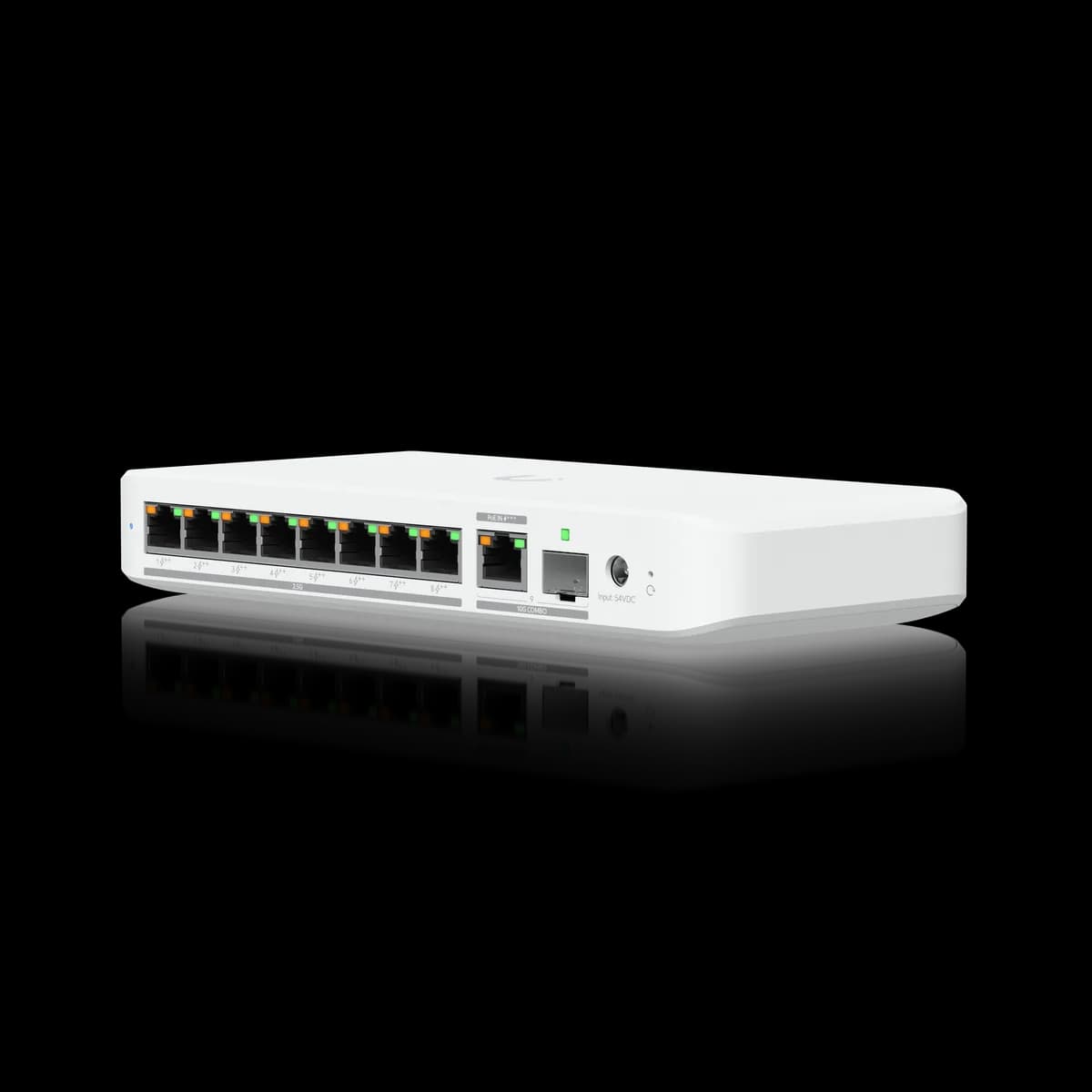
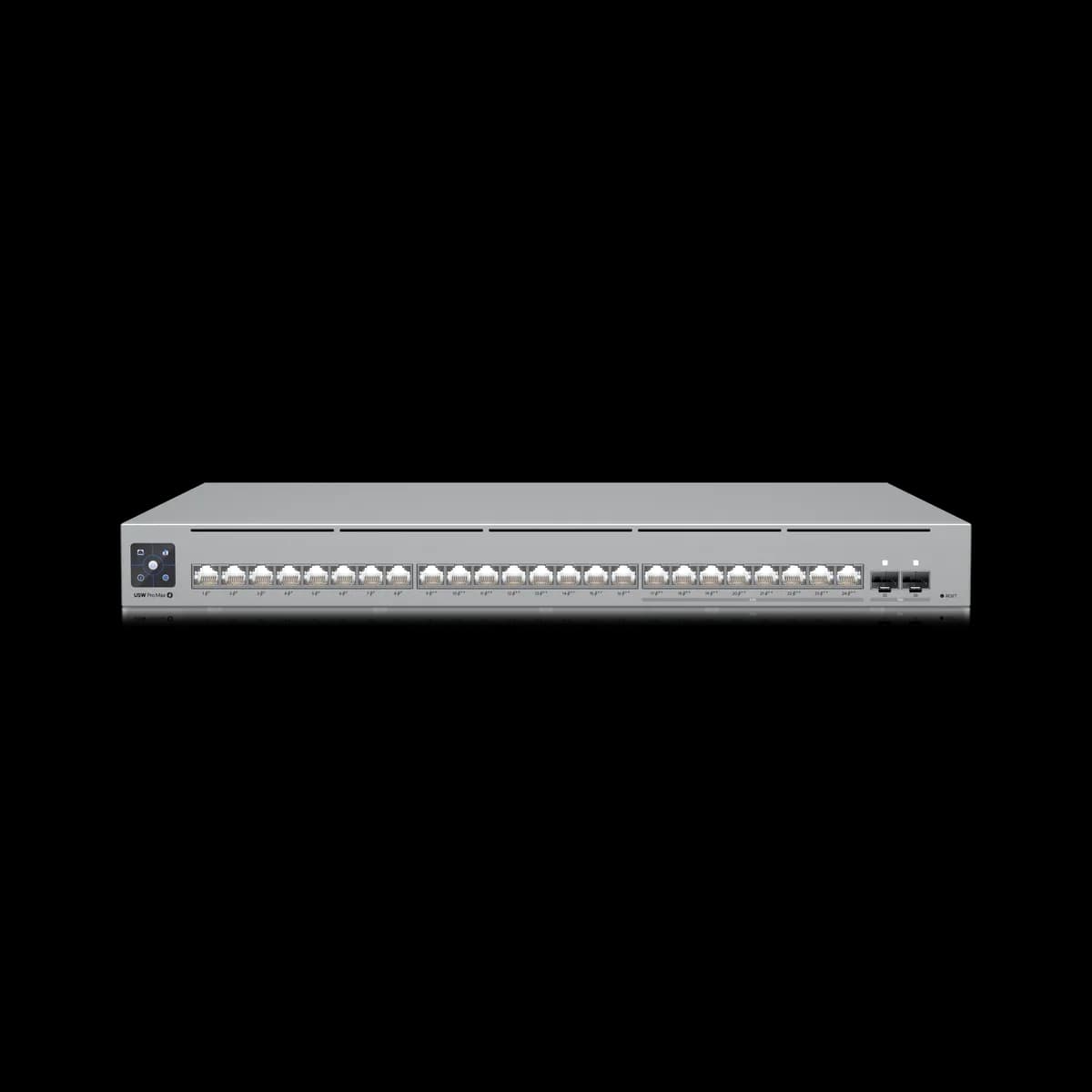
Comparison

UniFi Flex 2.5G 8 PoE vs Pro Max 24 PoE

The $199 Flex 2.5G 8 PoE is a Layer 2 desktop edge switch; the $799 Pro Max 24 PoE is a Layer 3 rack switch. Both run 2.5 GbE PoE — so which fits your build?

Do I need the compact Flex 2.5G 8 PoE or the rackmount Pro Max 24 PoE?

Buy the Flex 2.5G 8 PoE ($199, plus a ~$79 power adapter) when you need a small 8-port edge switch with multi-gig PoE and dual 10G uplinks. Step up to the Pro Max 24 PoE ($799) when you need more than eight ports, Layer 3 routing, a rack mount, or a 400 W PoE budget. Both deliver eight 2.5 GbE PoE ports, so this is a port-count, Layer 3, and form-factor decision — not a speed one.

Spec Comparison

SpecUniFi Flex 2.5G 8 PoEUniFi Pro Max 24 PoE
RJ45 Ports(8) 2.5 GbE (PoE++)(16) 1 GbE + (8) 2.5 GbE (8 PoE+, 16 PoE++)
Uplinks(1) 10G RJ45 + (1) 10G SFP+(2) 10G SFP+
PoE Ports824
PoE Standards802.3af / at / bt802.3at / bt
Total PoE Budget196 W400 W
Switching Capacity60 Gbps112 Gbps
LayerLayer 2Layer 2 + Layer 3
Form FactorDesktop / wall / DINRackmount (1U)
Max Power Draw210 W (incl. PoE)450 W (incl. PoE)
Power AdapterSold separatelyInternal
ManagementUniFi NetworkUniFi Network
Forwarding Rate83 Mpps

Two Different Jobs

What is the real difference? The Flex 2.5G 8 PoE is a compact Layer 2 edge switch for a desk, wall, or DIN rail; the Pro Max 24 PoE is a Layer 3 rackmount access switch. They share eight 2.5 GbE PoE ports but solve different jobs. (Pro Max specs)

The temptation is to read these as "small 2.5G switch" versus "big 2.5G switch" and pick on price. That framing misleads. The Flex 2.5G 8 PoE is built to live at the edge of a network — behind a desk, in a media cabinet, on a wall plate near a cluster of APs and cameras. It has eight ports total and no rack ears.

The Pro Max 24 PoE is built for the rack: 24 ports, an internal power supply, and Layer 3 routing for an entire access layer. At $799 against the Flex's $199, it is roughly four times the price because it does roughly four times the job. If you are mapping the whole lineup, how to choose a UniFi switch frames the edge-versus-rack split, or browse the Switches hub to see where each sits.

2.5 GbE Ports & Total Port Count

How many ports, and how many at 2.5 GbE? The Flex 2.5G 8 PoE has eight ports, all 2.5 GbE PoE. The Pro Max 24 PoE has 24 ports — eight at 2.5 GbE plus 16 at 1 GbE. Both give you exactly eight 2.5 GbE PoE ports; the Pro Max adds 16 gigabit ports. (Pro Max specs)

This is the spine of the decision. The multi-gig capacity is identical — eight 2.5 GbE PoE ports on each. The Flex 2.5G 8 PoE is all 2.5 GbE, which makes it dense for its size, but it stops at eight ports. The Pro Max is a mixed switch: the same eight 2.5 GbE ports, then 16 gigabit ports for the cameras, phones, and legacy clients that never exceed a gigabit.

So the question is not "which is faster at 2.5G" — they tie. It is "do I need more than eight ports?" If eight covers your edge, the Flex is the cheaper, smaller fit. If you are wiring a closet full of drops, the Pro Max's 24 ports are the point. For a closet that needs more ports but not multi-gig everywhere, the 24-port question — Pro vs Pro Max is the next comparison to read.

Layer 2 vs Layer 3

Does the Flex route? No. The Flex 2.5G 8 PoE is Layer 2 only — it switches and tags VLANs but cannot route between them. The Pro Max 24 PoE adds full Layer 3: inter-VLAN routing, a DHCP server, and static routes. (Pro Max specs)

For most edge deployments this gap does not matter. A Flex 2.5G 8 PoE hangs off a gateway or a Layer 3 core that already handles routing; the Flex just carries tagged VLAN traffic back upstream. Layer 2 is exactly what an edge switch is supposed to be.

Layer 3 becomes the reason to buy when the Pro Max is acting as the routing point for an access layer — routing between VLANs locally, serving DHCP, and holding static routes without sending every packet back to the gateway. If your topology already has a router or a Layer 3 aggregation switch, you do not need the Flex to route, and Layer 2 costs you nothing. If this switch is the brain of the segment, only the Pro Max can do that job.

PoE budget and uplinks? The Flex 2.5G 8 PoE carries a 196 W PoE budget with dual 10G uplinks — one 10G RJ45 and one 10G SFP+. The Pro Max 24 PoE doubles that to a 400 W budget over 24 ports, with two 10G SFP+ uplinks. (Pro Max specs)

The Flex's 196 W is generous for an eight-port switch — enough to drive a cluster of PoE++ APs and cameras at the edge. But note the catch: the Flex 2.5G 8 PoE ships without a power adapter, so budget roughly $79 for the brick on top of the $199 list price. Its 210 W maximum draw sets the ceiling for that external supply.

The Pro Max 24 PoE runs a 400 W budget from an internal power supply across 24 ports — more total headroom, but spread over three times the ports. The uplinks differ in kind: the Flex offers a flexible 10G RJ45 and a 10G SFP+, handy where you want a copper 10G run; the Pro Max gives two 10G SFP+ for fiber or DAC into an aggregation core. Tally your devices' draw against each budget, as the buying guide explains — that shared ceiling is the real constraint, not the port speed.

Form Factor & Price

Rack or desk, and what's the real cost? The Flex 2.5G 8 PoE is a desktop/wall/DIN-mount unit at $199 plus a ~$79 adapter (sold separately). The Pro Max 24 PoE is a 1U rackmount switch at $799 with an internal supply and Etherlighting port LEDs. (Pro Max specs)

Form factor often decides this on its own. If you have no rack — a home office, a retail counter, a small AV cabinet — the Flex 2.5G 8 PoE is designed to sit on a shelf, hang on a wall, or clip to a DIN rail. The Pro Max expects rack ears and a 1U slot.

On price, account for the whole bill. The Flex's true entry cost is closer to $278 once you add the adapter, but that is still well under half the Pro Max's $799. You are not paying that gap for faster 2.5G ports — both have eight — but for 16 extra gigabit ports, Layer 3, a 400 W budget, and the rack form factor. If your real question is which small switch fits a closet, the Lite 16 PoE vs Flex 2.5G 8 PoE comparison sizes that choice directly.

Who Should Buy Which

Once you have written down your port count, whether this switch needs to route, and whether you have a rack, the choice is rarely close. Here is how it breaks.

Buy the Flex 2.5G 8 PoE if:

  • You need eight ports or fewer at the edge. A desk, AV cabinet, or AP cluster — eight 2.5 GbE PoE ports cover it for $199 (plus the ~$79 adapter).
  • You have no rack. Desktop, wall, or DIN mounting fits where a 1U switch cannot go.
  • Routing happens elsewhere. A gateway or Layer 3 core already routes, so a Layer 2 edge switch is all you need.
  • You want flexible 10G uplinks. A 10G RJ45 and a 10G SFP+ let you uplink over copper or fiber.

Buy the Pro Max 24 PoE if:

  • You need more than eight ports. Twenty-four ports — eight at 2.5 GbE, 16 at 1 GbE — feed a full access layer.
  • This switch must route. Layer 3 inter-VLAN routing, DHCP, and static routes live on the Pro Max, not the Flex.
  • You are mounting in a rack. A 1U chassis with an internal supply and Etherlighting LEDs belongs in the closet.
  • You need a bigger PoE budget. 400 W across 24 ports powers far more endpoints than the Flex's 196 W.

Still sizing the lineup? Start with how to choose a UniFi switch, or if you have decided on a 24-port rack switch, weigh the Pro 24 PoE vs Pro Max 24 PoE.

Frequently Asked Questions

Neither — they tie. Both switches have exactly eight 2.5 GbE PoE ports. The Flex 2.5G 8 PoE is all eight of its ports at 2.5 GbE; the Pro Max 24 PoE has the same eight at 2.5 GbE plus 16 gigabit ports. The decision is about port count, Layer 3 routing, and form factor, not multi-gig speed.

No. The Flex 2.5G 8 PoE is sold without a power adapter, so you should budget roughly $79 for the brick on top of the $199 list price. Its maximum draw is 210 W. The Pro Max 24 PoE has an internal power supply, so there is no separate adapter to buy.

No. The Flex 2.5G 8 PoE is a Layer 2 switch — it tags and switches VLAN traffic but cannot route between VLANs. If you need inter-VLAN routing, a DHCP server, or static routes on the switch itself, you need the Layer 3 Pro Max 24 PoE, or a separate gateway or Layer 3 core.

The Flex 2.5G 8 PoE has eight ports, all 2.5 GbE PoE. The Pro Max 24 PoE has 24 ports: eight at 2.5 GbE and 16 at 1 GbE. Both give you the same eight 2.5 GbE ports; the Pro Max adds 16 gigabit ports for cameras, phones, and clients that never exceed a gigabit.

The $799 Pro Max 24 PoE is not faster at 2.5 GbE — both have eight 2.5 GbE ports. The premium over the $199 Flex buys 16 extra gigabit ports, Layer 3 routing, a 400 W PoE budget, a 1U rackmount chassis with an internal power supply, and two 10G SFP+ uplinks.