Comparison

UniFi G6 Bullet vs G6 Turret: Which Form Factor?

The $199 UniFi Protect G6 Bullet and G6 Turret share one 4K sensor. Compare form factor, IR range, power draw, cold-weather rating, and which body to mount.

Should I buy the UniFi G6 Bullet or the G6 Turret?

It is a tie on image and price — both the G6 Bullet and G6 Turret are $199 and share the same 1/1.8-inch 8MP 4K sensor, 109.9° field of view, 30 m IR range, and IP66/IK04 rating. Choose by mount and climate: the Bullet is the visible, lower-power (9.9 W) deterrent for walls and poles, while the Turret is the discreet eyeball that aims easily under an eave and is rated colder (-30 °C versus -20 °C). Neither has on-board storage, so both record to a UniFi gateway or NVR.

Spec Comparison

SpecUniFi Protect G6 BulletUniFi Protect G6 Turret
Form FactorOutdoor bulletOutdoor turret (eyeball)
Image Sensor1/1.8" 8MP1/1.8" 8MP
Max Resolution4K (3840 × 2160) at 30 fps4K (3864 × 2160) at 30 fps
Field of ViewH 109.9°H 109.9°
IR Night Vision30 m (98 ft)30 m (98 ft)
ConnectivityWired — 10/100 RJ45Wired — 10/100 RJ45
Power MethodPoEPoE
Max Power Draw9.9 W12.5 W
Weather / Vandal RatingIP66 / IK04IP66 / IK04
Operating Temp-20 to 50 °C (-4 to 122 °F)-30 to 50 °C (-22 to 122 °F)
AI DetectionsPerson, Vehicle, Animal + Face & License Plate (Multi-TOPS AI)Person, Vehicle, Animal + Face & License Plate (Multi-TOPS AI)

The Same Camera in Two Bodies

Same camera? Yes. Both the G6 Bullet and G6 Turret use a 1/1.8" 8MP sensor, output 4K at 30 fps, cover a 109.9° horizontal field of view, see 30 m (98 ft) in IR, and run the same Multi-TOPS AI engine for person, vehicle, and animal detection. The image is effectively identical — only the housing differs. (G6 Bullet specs)

This is the unusual thing about choosing between these two: it is not a quality decision. The G6 Bullet and G6 Turret sit in the same G6 generation, at the same $199, with matching optics, the same 30 m night vision, and the same person/vehicle/animal smart detections. Whichever you mount, the footage looks the same.

So the comparison comes down to the body: how it mounts, how visible it is, how much power it pulls, and how cold it can run. If you are still mapping the whole lineup, start with how to choose a UniFi camera or browse the Security Cameras hub.

Bullet vs Turret: Housing & Deterrence

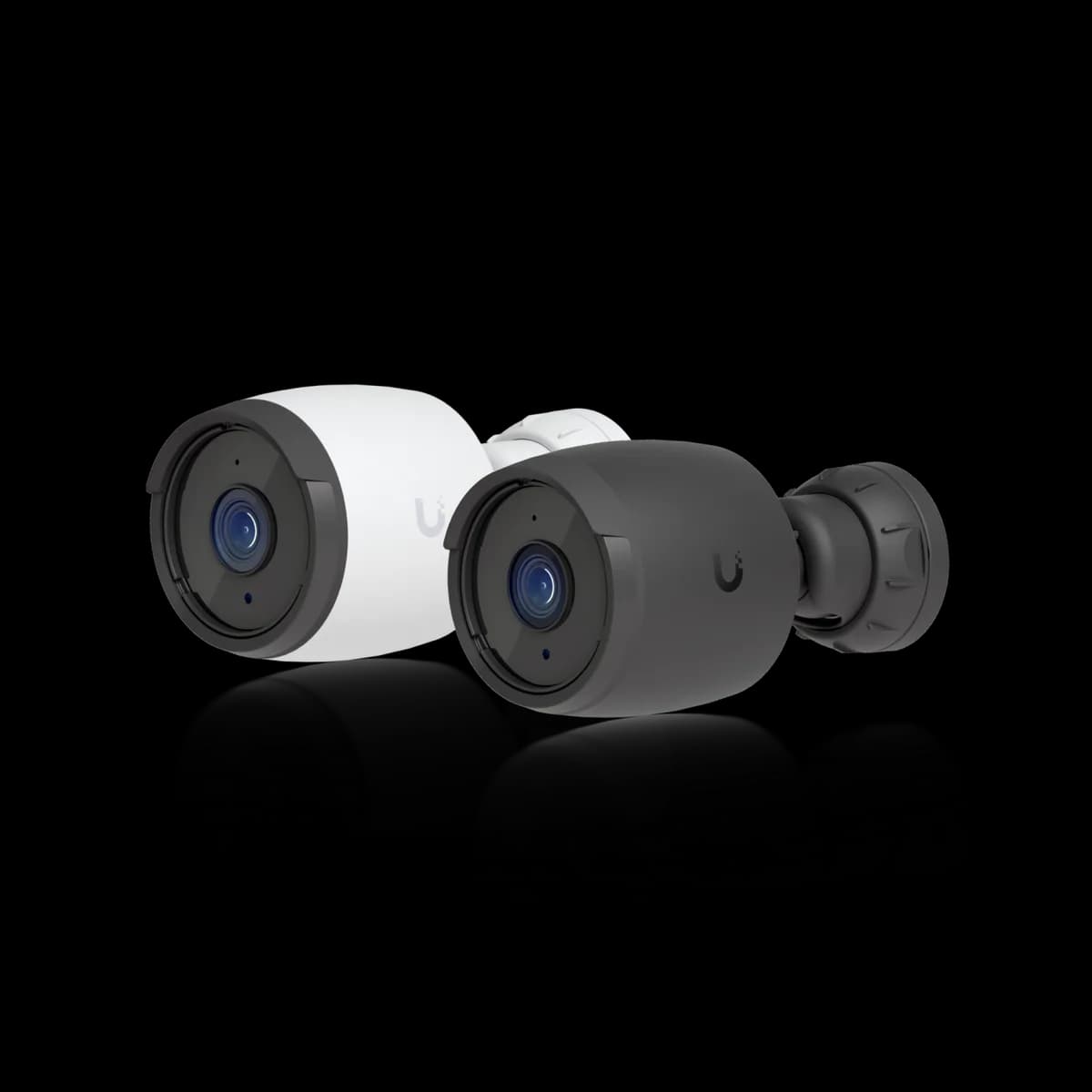
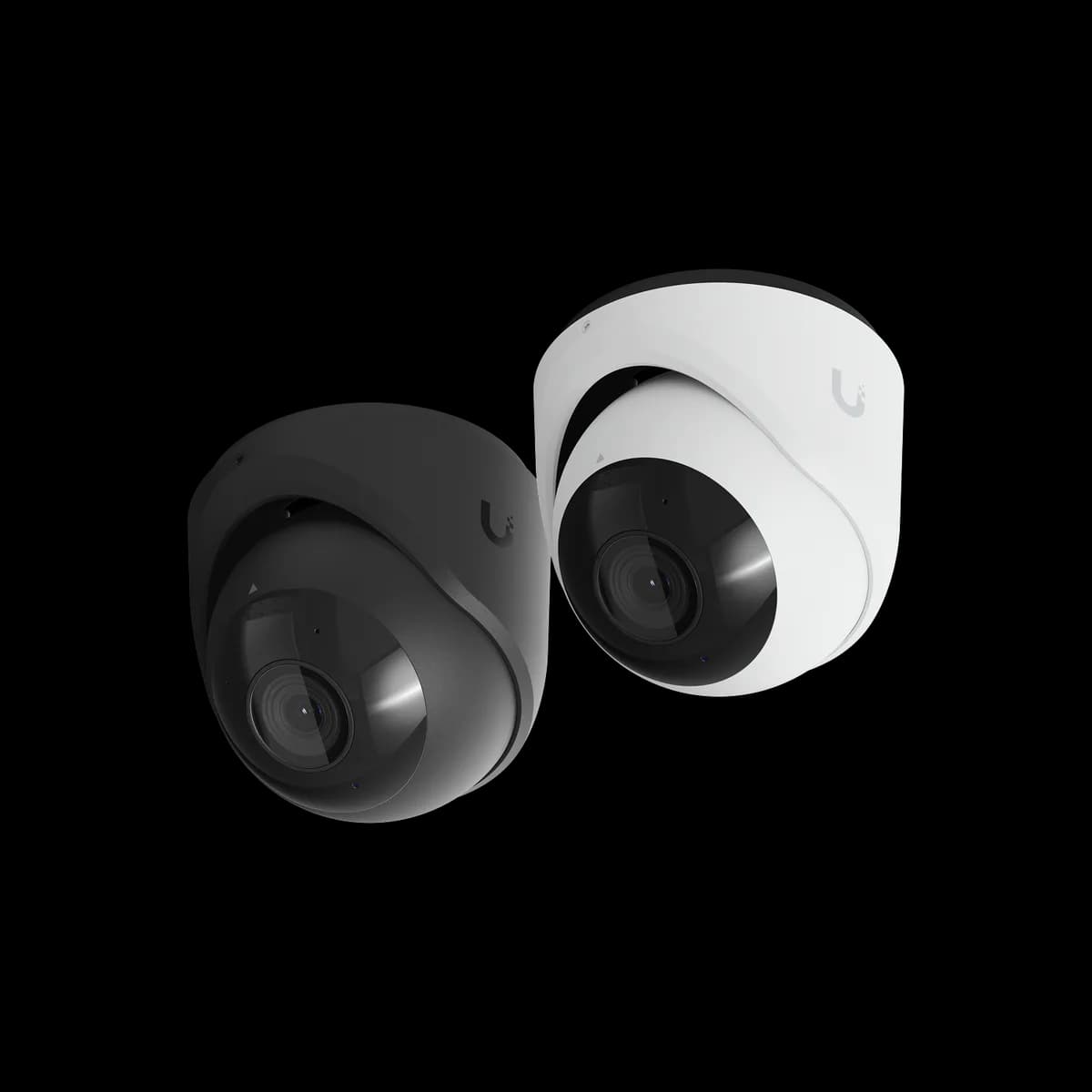
Which body mounts better? The G6 Bullet is a visible cylindrical camera that points along a wall or eave and acts as an obvious deterrent. The G6 Turret is a recessed eyeball that sits flatter to the surface, aims with a ball joint, and draws less attention — and its recessed lens resists the IR glare and spider-webbing that can plague a protruding bullet.

Pick the G6 Bullet when you want the camera seen — a visible bullet on a soffit or pole tells a would-be intruder they are on camera, and its barrel shape makes the aim direction obvious. It is the classic deterrent form.

Pick the G6 Turret when you want the camera to disappear into the eave. The eyeball sits in its housing and pivots on a ball, so it is quick to aim precisely and harder to grab or knock out of alignment. The recessed lens also keeps the IR LEDs separated from the glass, which cuts the night-time glare-and-haze problem bullets sometimes show. The other moving-camera option, the G6 PTZ, is a different decision entirely.

Power Draw & PoE

Different power? Both are wired cameras powered over a single Ethernet run (10/100 RJ45). The G6 Bullet draws up to 9.9 W and the G6 Turret up to 12.5 W. Ubiquiti lists both simply as "PoE" without naming an 802.3 class, and at these wattages a standard PoE switch port powers either one. (G6 Turret specs)

The 2.6 W difference between them is small but real: on a fully loaded PoE switch budget, a wall of Bullets leaves a little more headroom than a wall of Turrets. Neither needs PoE+ — unlike the G6 PTZ, which draws 24.5 W and does require 802.3at.

If you are sizing the switch that will feed a run of cameras, how to choose a UniFi switch walks through PoE budget and port count. Either camera is an easy load.

Weatherproofing & Cold-Weather Rating

Better in harsh weather? Both carry an IP66 weatherproof and IK04 impact rating, so both shrug off rain and dust outdoors. The split is temperature: the G6 Turret is rated to -30 °C (-22 °F) while the G6 Bullet is rated to -20 °C (-4 °F). In a very cold climate the Turret has the wider operating margin.

For most installs the IP66 rating is the part that matters, and it is identical — both are genuine outdoor cameras, not the splash-resistant IPX5 of the indoor G6 Instant. Mounted under an eave, either will run for years.

The 10 °C difference in the low-temperature rating only decides things at the extremes. If you are mounting on an exposed north wall in a region that sees hard winters, the G6 Turret's -30 °C rating is the safer spec. In a temperate climate it is a non-issue and the choice falls back to form factor.

What You Need to Run Them

What do you need to run them? Three things: a PoE switch port for power and data, a UniFi gateway or NVR running UniFi Protect to record, and storage on it. Neither the G6 Bullet nor the G6 Turret has a microSD slot, so the recorder is not optional — the footage has to land somewhere.

Both cameras plug into the same UniFi Protect system. They uplink over Ethernet to a PoE switch, which carries power and data on one cable, and that switch connects to a gateway — a Dream Machine or Cloud Gateway with a Protect drive, or a dedicated NVR — that does the recording and AI processing.

Because neither camera records to on-board microSD, sizing the recorder is part of the buy. A gateway with Protect storage is the usual home for a small camera count; larger installs move to a dedicated NVR. Plan the switch and gateway alongside the cameras, not after.

Who Should Buy Which

Because the image, price, IR range, and weather rating all match, the decision is refreshingly simple — it is about the body, the mounting surface, and the climate.

Buy the G6 Bullet if:

  • You want a visible deterrent. A bullet on a wall or pole announces itself; that is the point.
  • You are mounting on a flat wall, soffit, or pole where pointing a barrel along the surface is natural.
  • PoE budget is tight. At 9.9 W it is the lighter load of the two on a crowded switch.

Buy the G6 Turret if:

  • You want the camera to be discreet and sit flush under an eave rather than stick out.
  • You need easy, precise aiming — the eyeball's ball joint points anywhere quickly.
  • You install in a very cold climate and want the -30 °C rating, or you have had IR glare problems with bullets before.

Still deciding across the range? Start with how to choose a UniFi camera, weigh the indoor option in G6 Instant vs G6 Bullet, or step up to motorized coverage in G6 Turret vs G6 PTZ. Or browse the full Security Cameras hub.

Frequently Asked Questions

Yes. Both use the same 1/1.8-inch 8MP sensor, record 4K at 30 fps, cover a 109.9° horizontal field of view, and see 30 m (98 ft) in IR. They run the same Multi-TOPS AI engine for person, vehicle, and animal detection. The image is effectively identical — the difference between them is the housing, not the optics.

Both are rated IP66 for weather and IK04 for impact, so both are true outdoor cameras. The only outdoor difference is the low-temperature rating: the G6 Turret is rated to -30 °C and the G6 Bullet to -20 °C. In a temperate climate either is fine; in a region with hard winters the Turret has more margin.

No. The G6 Bullet draws up to 9.9 W and the G6 Turret up to 12.5 W, and Ubiquiti lists both as standard PoE. A normal UniFi PoE switch port powers either. Only the G6 PTZ in this lineup requires PoE+ (802.3at), at 24.5 W.

No. Neither camera has a microSD slot, so both need a UniFi gateway running Protect (a Dream Machine or Cloud Gateway with a Protect drive) or a dedicated NVR to record. Plan that recorder and its storage as part of the purchase.

Power draw is not really the deciding factor — both are light loads. The 9.9 W versus 12.5 W difference only matters on a PoE switch that is already near its budget across many cameras. Choose between them on form factor and cold-weather rating, not wattage.