Comparison

Dream Router vs Cloud Gateway Ultra

The $199 Dream Router is an all-in-one with Wi-Fi 6, PoE, and a Protect SSD; the $129 Cloud Gateway Ultra adds 2.5 GbE WAN and more clients. Which to buy?

Should I buy the UniFi Dream Router or the Cloud Gateway Ultra?

Buy the Dream Router ($199) if you want one box that is the gateway, Wi-Fi 6 AP, PoE switch, and Protect NVR for a small home. Choose the Cloud Gateway Ultra ($129) when you will add your own access point and switch — it adds a 2.5 GbE WAN and doubles client headroom to 300+.

Spec Comparison

SpecUniFi Dream RouterUniFi Cloud Gateway Ultra
ProcessorDual-core ARM Cortex-A53 @ 1.35 GHzQuad-core ARM Cortex-A53 @ 1.5 GHz
On-Board Storage128 GB SSD16 GB
WAN Port(1) GbE RJ45(1) 2.5 GbE RJ45
LAN Ports(5) GbE RJ45, (2) with PoE(4) GbE RJ45
PoE Output40 W total budget (15.4 W max/port)
Integrated Wi-FiWi-Fi 6 — 2.4 Gbps (5 GHz) + 600 Mbps (2.4 GHz)
IDS/IPS Throughput1 Gbps1 Gbps
Form FactorCompact desktopCompact desktop
Max UniFi Devices20+30+
Max Clients150+300+
Max Power Draw19.37 W (excl. PoE output)6.2 W
System Memory3 GB

All-in-One vs Modular

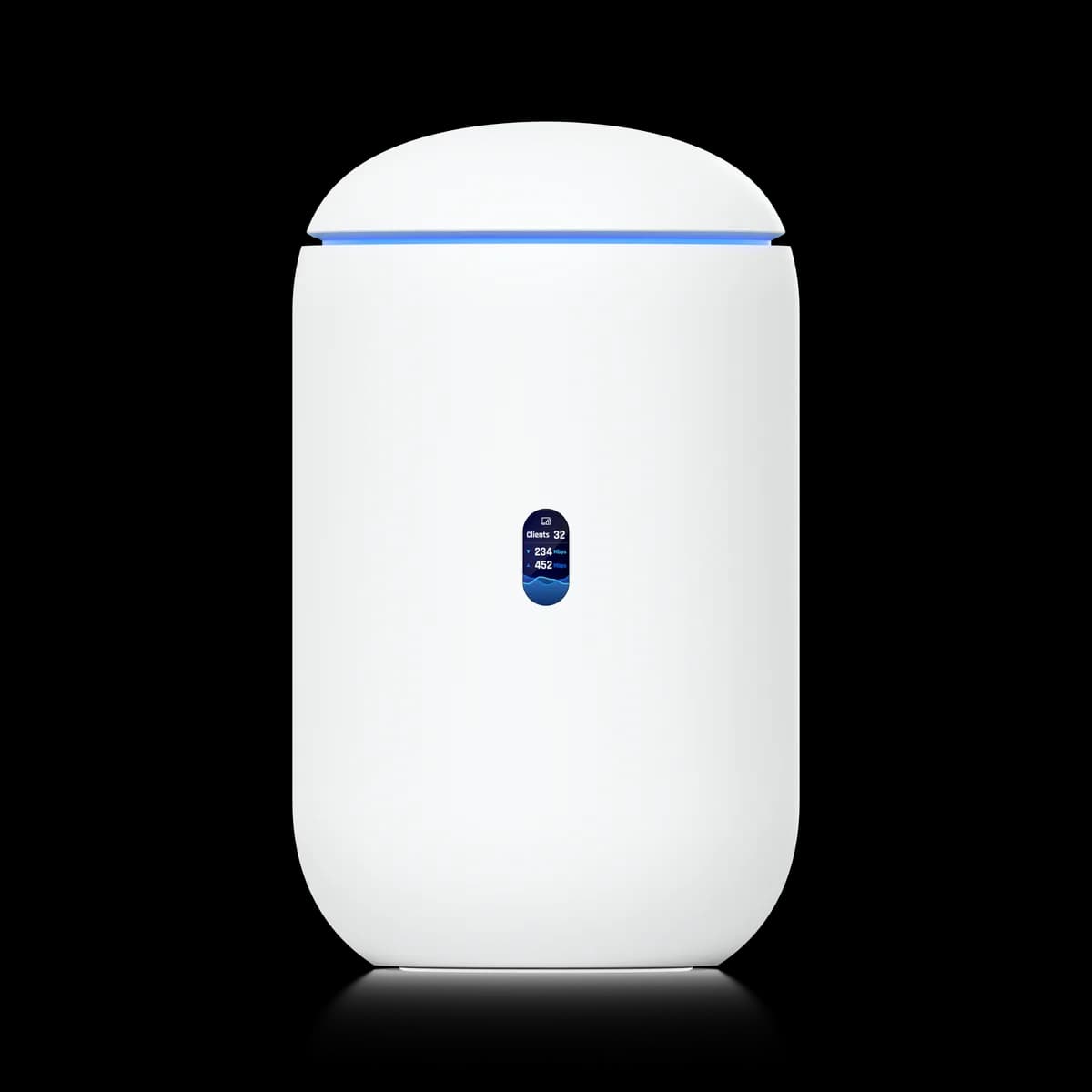
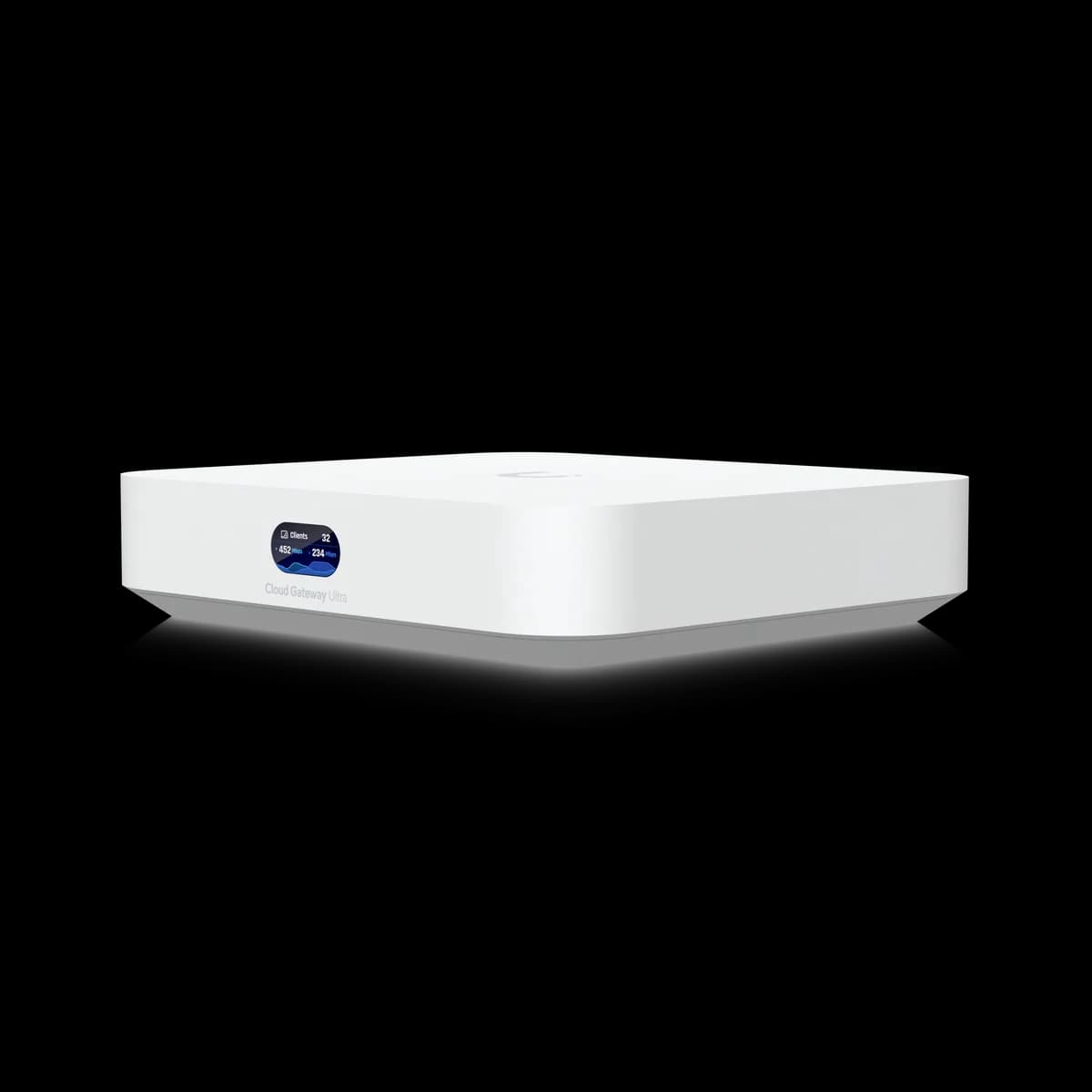
Which is the more complete box? The Dream Router is an all-in-one at $199 — gateway, Wi-Fi 6 AP, 5-port PoE switch, and Protect NVR in one unit. The Cloud Gateway Ultra is a modular $129 router with no Wi-Fi and no storage, built to pair with your own gear. (UDR specs)

These two gateways answer the same question with opposite philosophies. The Dream Router collapses a whole UniFi network into a single desktop unit — plug in WAN, broadcast Wi-Fi, power two PoE devices, and record cameras, all from one box. The Cloud Gateway Ultra deliberately does less: it routes and firewalls, then hands Wi-Fi and switching off to dedicated hardware you choose.

The split decides your parts list before any spec does. A Dream Router can be a complete network by itself for $199; the Cloud Gateway Ultra is the cheaper router, but a usable network around it needs at least an access point, which narrows the real gap. If neither fits, the rackmount UDM-Pro is the tier above — that path is mapped in how to choose a UniFi gateway and the Gateways & Routers hub.

Wi-Fi: Integrated vs None

Does either broadcast Wi-Fi? Only the Dream Router does — it has integrated Wi-Fi 6 rated at 2.4 Gbps (5 GHz) plus 600 Mbps (2.4 GHz). The Cloud Gateway Ultra has no radio at all and needs a separate access point to put any device on wireless. (UCG-Ultra specs)

This is the headline difference. The Dream Router is a router and an access point in one chassis, so a small home is covered the moment it powers on — no second purchase. The catch is placement: the built-in AP can't be repositioned, so coverage is wherever the router physically sits, which is often a wiring closet or a desk in a corner rather than the center of the home.

The Cloud Gateway Ultra has no radio, so it relies entirely on a separate UniFi access point. That sounds like a drawback, but it is also the modular advantage: you place the AP where coverage is actually needed and pick the exact model your space demands. For a single-box network the Dream Router wins outright; for a tuned wireless deployment the Ultra-plus-AP pairing is the stronger long-term shape.

WAN & Multi-Gig

Which keeps up with multi-gig internet? The Cloud Gateway Ultra has a 2.5 GbE WAN that accepts plans above 1 Gbps; the Dream Router is 1 GbE WAN only and caps at gigabit. Both inspect traffic at the same 1 Gbps IDS/IPS rating, so neither routes protected traffic faster than the other. (UCG-Ultra specs)

Read this one carefully, because the numbers are easy to misjudge. The Cloud Gateway Ultra takes a 2.5 GbE WAN feed, so a multi-gig plan physically links up; the Dream Router tops out at a 1 GbE WAN and cannot accept more than gigabit on the internet side. If your ISP plan is faster than 1 Gbps, that port limit alone rules the Dream Router out.

Where the two are identical is threat inspection. Both gateways are rated at 1 Gbps of IDS/IPS throughput, so with full intrusion detection enabled neither one inspects traffic faster than the other — the Ultra's 2.5 GbE port is about link speed, not protected speed. The honest takeaway: the Ultra's edge here is the WAN port, which matters only on a faster-than-gigabit line. On a standard gigabit connection the two route identically.

PoE & Protect Storage

Can either power and record cameras? Only the Dream Router can do both: 2 PoE LAN ports (40 W total, 15.4 W/port max) drive cameras directly, and a 128 GB SSD records them as a Protect NVR. The Cloud Gateway Ultra has no PoE and no storage, so cameras need a separate switch and recorder. (UDR specs)

For a small UniFi Protect deployment, this section usually decides the buy. The Dream Router powers PoE devices on two of its LAN ports and records to its onboard 128 GB SSD, so a couple of cameras work straight out of the box with no extra appliance. Mind the budget, though: PoE is capped at 15.4 W per port and 40 W total, which comfortably runs standard UniFi cameras but won't feed power-hungry PoE++ hardware.

The Cloud Gateway Ultra does neither — no PoE output and no Protect storage. Pairing it with cameras means buying a PoE switch to power them and a separate UniFi Protect NVR to record them, both real added costs. That is the cleanest way to see the trade: the Dream Router's $199 already includes the camera plumbing, while the Ultra's lower $129 sticker grows once cameras enter the plan. The rackmount route to the same NVR feature is the UDM-Pro, weighed in UDM-Pro vs Cloud Gateway Ultra.

Capacity Ceilings

Which scales further? The Cloud Gateway Ultra is rated for 30+ UniFi devices and 300+ clients; the Dream Router tops out lower at 20+ devices and 150+ clients. For a growing network — more APs, cameras, and wireless gear over time — the Ultra has roughly double the client headroom. (UCG-Ultra specs)

Capacity is where the modular box quietly pulls ahead. The Cloud Gateway Ultra is rated to manage 30+ UniFi devices and 300+ concurrent clients, while the Dream Router is the lowest-capacity gateway in the lineup at 20+ devices and 150+ clients. On a small home today either is fine, but a network that keeps adding access points, cameras, and IoT devices will reach the Dream Router's ceiling first.

The pattern is consistent with their philosophies: the all-in-one Dream Router is tuned for a contained single-box network, while the Ultra is built to anchor a deployment that grows around it. If you expect the device count to climb past a hundred clients, the Ultra is the more future-proof router — and if it climbs much further, the UDM-Pro at 1,000+ clients is the next step up.

Who Should Buy Which

The two gateways rarely suit the same buyer once the requirements are written down. Here is how the decision usually breaks.

Buy the Dream Router if:

  • You want one box, not four. Gateway, Wi-Fi 6, a 5-port PoE switch, and a Protect NVR in a single $199 unit — the simplest possible first UniFi network.
  • You want cameras cheaply. Two PoE ports plus a 128 GB SSD record a few UniFi Protect cameras with no separate switch or recorder.
  • Your internet is gigabit or slower. The 1 GbE WAN is no constraint on a standard gigabit line, and the integrated AP covers a small home.

Buy the Cloud Gateway Ultra if:

  • You will add your own AP and switch. As a pure modular router it lets you place Wi-Fi where it's needed and scale switching independently.
  • Your plan is faster than gigabit. Its 2.5 GbE WAN accepts multi-gig internet that the Dream Router's 1 GbE port cannot.
  • You expect to grow. Rated for 30+ devices and 300+ clients, it has roughly double the headroom of the Dream Router for a fraction more router.

Still weighing the wider lineup? Start with how to choose a UniFi gateway, or compare each against the rackmount tier in UDM-Pro vs Dream Router and UDM-Pro vs Cloud Gateway Ultra.

Frequently Asked Questions

No. The Cloud Gateway Ultra has no built-in radio and cannot broadcast Wi-Fi on its own — you pair it with a separate UniFi access point. The Dream Router is the gateway in this matchup with integrated Wi-Fi 6, rated at 2.4 Gbps on 5 GHz plus 600 Mbps on 2.4 GHz.

Yes. The Dream Router has two PoE-capable LAN ports with a 40 W total budget and 15.4 W per port, enough to power a couple of standard UniFi Protect cameras directly. It also records them to its onboard 128 GB SSD, so no separate NVR is needed. It cannot feed power-hungry PoE++ devices.

The Cloud Gateway Ultra. It has a 2.5 GbE WAN port that accepts internet plans faster than 1 Gbps, while the Dream Router has a 1 GbE WAN and caps at gigabit. Note that both gateways inspect traffic at the same 1 Gbps IDS/IPS rating, so the Ultra's advantage is the link speed of the WAN port itself.

Yes. Both are full UniFi gateways, so you can adopt additional UniFi access points and switches into either at any time. The Cloud Gateway Ultra requires at least one AP from the start since it has no radio; the Dream Router already includes Wi-Fi 6, so you would add APs only to extend coverage beyond the router's fixed location.